Hiranar, Bastar, Chhattisgarh — In a country where national honours often go to names that dominate headlines, the story of Dr Budhri Tati Padma Shri recognition is a quiet reminder that the most transformative work happens far from the spotlight — in dusty village roads, in forested hamlets, and in the lives of women who had never imagined a world beyond their fields.
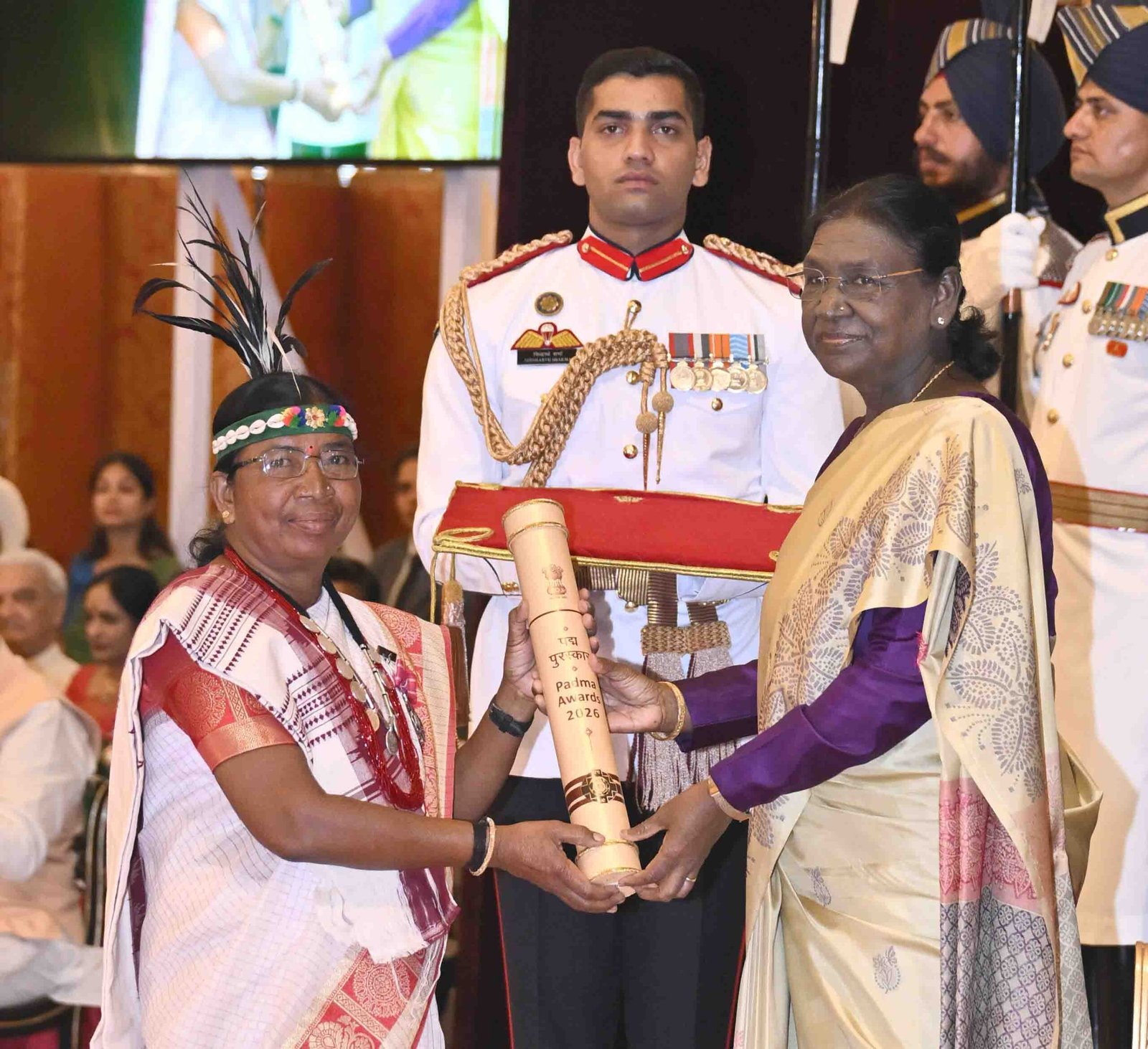
Dr Budhri Tati, President of the Maa Shakhini Mahila Utthan Kendra in Hiranar village, Bastar district, has been conferred the Padma Shri for her four decades of dedicated grassroots social work. Her journey — from a poor tribal family in one of India’s most remote and conflict-affected regions to the national stage — is the kind of story that exam aspirants should study, journalists should tell, and policymakers should remember.
Who Is Dr Budhri Tati?
Dr Budhri Tati was born on 15 September 1966 into a poor family in Hiranar village, located in the Sudarshanchal region of Bastar, Chhattisgarh. Bastar is known for its dense forests, its indigenous tribal communities, and — in more recent decades — for the Naxal insurgency that has shaped its social and political landscape. Growing up in this environment, Dr Budhri experienced firsthand the hardships that tribal women and families face: limited access to education, economic dependence, social isolation, and the constant shadow of conflict.
At the age of 15, in 1981, she received initiation from Swami Sada Premanand Ji Maharaj, founder of the Ohumar Gunda Ashram, along with Divya Jeevan. That early spiritual grounding gave her a sense of purpose that would define the rest of her life. On 24 January 1984, she joined the All-India Vanvasi Kalyan Ashram and received training in social work as a volunteer at the Rashtriya Sevika Samiti in Nagpur. The training equipped her with the tools and frameworks she would need to work in some of India’s most challenging terrain.
The Beginning — Women’s Awakening in Bastar’s Forests
In 1986, Dr Budhri Tati began what would become her life’s mission. She chose Barsur — a small town in Bastar district steeped in ancient history — as the centre of an intensive outreach programme. Her method was simple but painstaking: trekking through the rugged, often inaccessible forest areas of Bastar district, meeting tribal women in their villages, listening to their struggles, and gently encouraging them to see education and self-reliance as possibilities rather than luxuries.
In a region where women’s voices were rarely heard and where access to basic services was a daily battle, this was not the kind of work that attracted funding or media attention. It was the kind of work that demanded patience, physical endurance, and an unshakeable belief that change was possible even in the hardest of circumstances.
Education for Tribal Girls — The Hostel That Changed Everything
In 1990, Dr Budhri inaugurated a girls’ hostel in Barsur with just 11 girls. The concept was straightforward: if tribal girls could not access schools because of distance, poverty, or social barriers, the school — or at least a safe place to stay near one — would come to them.
That small hostel has since grown into a larger mission. Today, a free hostel for 50 girls operates in Hauranar village. Students at the hostel receive education from primary level through higher education. The Maa Sharda Girls’ Hostel has been running continuously and free of charge since 2013, removing the financial barrier that keeps many tribal families from sending their daughters to school.
For many of these girls, the hostel is not just a place to study. It is the first environment they have encountered where education is valued, where their aspirations are taken seriously, and where the possibility of a different life becomes real.
Self-Employment and Economic Empowerment for Women
Dr Budhri understood early on that education alone was not enough. Without economic independence, tribal women would remain vulnerable to the same cycles of poverty and dependence that had defined previous generations. With the help of social support and community fundraising, she constructed a permanent women’s training centre in Barsur and later built the Hiranar Women’s Upliftment Centre.
These centres provide practical skills training for self-employment, equipping women with the ability to earn their own livelihood. The Hiranar centre has become a hub for women’s activities in the region, hosting training programmes, community meetings, and awareness campaigns on health, education, and legal rights.
Every year on 30 January, the centre hosts the Mata Shakti Sammelan — a conference of tribal women that brings together participants from across the region to share experiences, discuss challenges, and celebrate their collective strength.
Work in Naxal-Affected Areas
What makes Dr Budhri Tati’s work even more remarkable is the context in which she has carried it out. Bastar has been one of the regions most affected by the Naxal insurgency in India. Working in areas where armed conflict, displacement, and fear are part of daily life requires a kind of courage that does not come from training alone — it comes from conviction.
Dr Budhri has participated in social service activities in Naxal-affected areas, continuing her work with tribal communities even when the security situation made it dangerous. Her presence in these areas sent a powerful message: that the work of education, empowerment, and community building cannot wait for peace — it is, in fact, one of the surest paths toward achieving it.
Social Harmony — Bridging Divides Through Culture
In a region where caste, tribal identity, and community boundaries can create deep divisions, Dr Budhri has used cultural initiatives as tools for social cohesion. One of her most distinctive efforts involves using the festival of Rakshabandhan as a means of connecting tribal and forest-dwelling communities through what she calls “the unbreakable bond of love.”
Through the Bal Sanskaar Kendra, children between the ages of three and five are taught short stories, poems, playful counting, jokes, and good manners — laying the foundation for values-based education from the earliest age. In the area of education outreach, tribal villages are regularly visited to encourage parents to send their children to school, addressing the dropout problem at its root.
Awards and Recognition — A Legacy of Honours
Dr Budhri Tati’s four decades of service have been recognised through numerous awards at the state and national level. Each honour marks a different chapter in her journey and a different dimension of her work.
| Year | Award | Awarded By |
|---|---|---|
| 1998 | Bhartiya Stree Shakti Puraskar | Nagpur |
| 2007 | Minimata Award for Women’s Upliftment | Chhattisgarh State Government |
| 2014 | Rani Gaidinliu Award | Devi Ahilya Smarak Samiti, Nagpur |
| 2018 | Mahatma Jyotiba First Fellowship Award | National |
| 2018 | Sant Ishwar Vishisht Seva Samman | National |
| 2022 | Baap Kavi Award | Maharishi Karve Training Institute, Pune |
| — | Honorary Doctor of Philosophy (PhD) | Pt. Sundarlal Sharma Open University, Bilaspur, Chhattisgarh |
| 2026 | Padma Shri | Government of India |
The Padma Shri — India’s fourth-highest civilian honour — is the culmination of a lifetime spent in service. But for Dr Budhri, it is unlikely to change the rhythm of her daily work. The girls in the hostel still need meals, the women in the training centre still need guidance, and the villages in the forests of Bastar still need someone willing to walk the distance.
Why Dr Budhri Tati’s Padma Shri Matters
In an era when awards are sometimes given for visibility rather than impact, Dr Budhri Tati’s Padma Shri sends a clear signal. The Government of India has chosen to honour a woman whose work has never been glamorous, whose name has not trended on social media, and whose achievements cannot be measured in headlines — only in the lives she has changed.
Her story matters for several reasons:
- It validates grassroots work. For every Dr Budhri, there are thousands of unnamed social workers in India’s villages whose contributions go unrecognised. A Padma Shri for a tribal woman from Bastar tells them that their work counts.
- It highlights tribal women’s empowerment. India’s tribal communities, and tribal women in particular, face some of the deepest developmental challenges in the country. Dr Budhri’s work addresses these challenges at the most fundamental level — through education, skills training, and community building.
- It brings Bastar into the national conversation. Bastar is often discussed only through the lens of conflict. Dr Budhri’s story reminds the country that the same region produces extraordinary individuals who choose to serve rather than leave.
- It demonstrates the power of sustained commitment. Four decades of continuous work in one of India’s toughest regions is not a project — it is a life. The Padma Shri acknowledges that kind of commitment.
Impact on Chhattisgarh
Dr Budhri Tati’s Padma Shri is a proud moment for Chhattisgarh, a state that has produced remarkable individuals across fields but often struggles to receive national attention for its contributions.
For Bastar district specifically, the recognition shines a spotlight on the region’s potential. When a woman from a poor tribal family in Hiranar village can rise to receive one of India’s highest civilian honours, it changes the narrative — not just about Bastar, but about what is possible for every child growing up in similar circumstances.
The honour also draws attention to the work still needed. Chhattisgarh’s tribal areas continue to face challenges in education, healthcare, infrastructure, and economic opportunity. Dr Budhri’s story is an inspiration, but it is also a reminder that the ground reality for millions of tribal women remains difficult and that sustained investment in grassroots institutions is essential.
UPSC and Competitive Exam Relevance
UPSC Prelims
Dr Budhri Tati’s story can appear in questions related to Padma awardees, tribal welfare schemes, women’s empowerment initiatives, and Chhattisgarh-specific current affairs. The Padma Shri is a standard topic in the awards and honours section of competitive exams.
UPSC Mains
GS Paper I — Social empowerment, communalism, regionalism, and the role of individuals in social reform. Dr Budhri’s work on social harmony through Rakshabandhan and cross-community engagement is directly relevant.
GS Paper II — Welfare schemes for vulnerable sections, mechanisms for their protection, and the role of NGOs and civil society. The Nirbhay Chetna initiative and women’s safety governance at the Panchayat level connect to Dr Budhri’s grassroots approach.
GS Paper III — Inclusive growth and issues arising from it, particularly in tribal and rural areas. Self-employment training, economic empowerment of women, and development in conflict-affected regions.
Essay Paper — Topics on women’s empowerment, the role of individuals in nation-building, tribal development, and the importance of grassroots leadership.
State PSC Examinations
Chhattisgarh PSC aspirants should note Dr Budhri Tati’s Padma Shri as a key current affairs item. Questions on state-specific Padma awardees, tribal welfare, women’s empowerment programmes, and Bastar’s development challenges are common in CGPSC examinations.
Other Examinations
SSC, Banking, and other competitive examinations regularly include questions on Padma awardees. Dr Budhri Tati’s name, her association with Bastar and Chhattisgarh, and the nature of her work should be noted for quick recall.
Frequently Asked Questions
Who is Dr Budhri Tati?
Dr Budhri Tati is a tribal social worker from Hiranar village in Bastar district, Chhattisgarh. She is the President of the Maa Shakhini Mahila Utthan Kendra and has spent over four decades working on women’s education, self-employment training, and community development in tribal and Naxal-affected areas.
Why has Dr Budhri Tati been awarded the Padma Shri?
Dr Budhri Tati has been conferred the Padma Shri for her four decades of dedicated grassroots social work, particularly her efforts in educating tribal girls, empowering women with self-reliance through skills training, and promoting social harmony in the Bastar region of Chhattisgarh.
What is the Maa Shakhini Mahila Utthan Kendra?
The Maa Shakhini Mahila Utthan Kendra, based in Hiranar village, Bastar, is the organisation led by Dr Budhri Tati that runs women’s training centres, girls’ hostels, children’s education programmes, and community outreach initiatives for tribal women and families.
When was Dr Budhri Tati born?
Dr Budhri Tati was born on 15 September 1966 in Hiranar village, Sudarshanchal, Bastar district, Chhattisgarh.
What awards has Dr Budhri Tati received before the Padma Shri?
Dr Budhri Tati has received the Bhartiya Stree Shakti Puraskar (1998), Minimata Award from the Chhattisgarh Government (2007), Rani Gaidinliu Award (2014), Mahatma Jyotiba First Fellowship Award (2018), Sant Ishwar Vishisht Seva Samman (2018), Baap Kavi Award (2022), and an honorary PhD from Pt. Sundarlal Sharma Open University, Bilaspur.
How many girls does the free hostel run by Dr Budhri Tati support?
The free hostel currently operates in Hauranar village and supports 50 girls, providing them education from primary level through higher education. The Maa Sharda Girls’ Hostel has been running continuously and free of charge since 2013.
The Last Word
Dr Budhri Tati’s Padma Shri is not just an award — it is an acknowledgement that the most important work in India often happens in places that the rest of the country never sees. For forty years, in the forests and villages of Bastar, one woman has been doing what governments, programmes, and policies aspire to do: changing lives, one at a time, through education, empowerment, and an unwavering belief in the dignity of every tribal woman and girl.
Her journey from a poor family in Hiranar to the national honours list is a story that every Chhattisgarh citizen can be proud of and every competitive exam aspirant should know. It is also a challenge — to recognise, support, and invest in the thousands of unnamed social workers across India who carry forward similar missions every single day, without recognition, without funding, and without the expectation that anyone is watching.
India’s Padma awards are at their best when they honour people like Dr Budhri Tati. Not for fame, not for politics, but for the simple, extraordinary act of showing up — for forty years — in the places that need it the most.
Published by TheExamHub.in | Updated: June 2026 | Source: Government of India Padma Awards, Maa Shakhini Mahila Utthan Kendra