By Ishan Verma, Founder & Editor TheExamHub.in | June 23, 2026
In a major step toward modernizing agricultural trade and strengthening cooperative frameworks, Union Home Minister and Minister of Cooperation Shri Amit Shah officially launched the NAFEX.in e-auction portal. Developed by the National Agricultural Cooperative Marketing Federation of India Ltd. (NAFED), this state-of-the-art digital platform aims to introduce absolute transparency in agricultural trade. By eliminating middlemen and ensuring direct bank payments, the new e-auction portal will serve as a game-changer for over 74 lakh farmers across the nation.
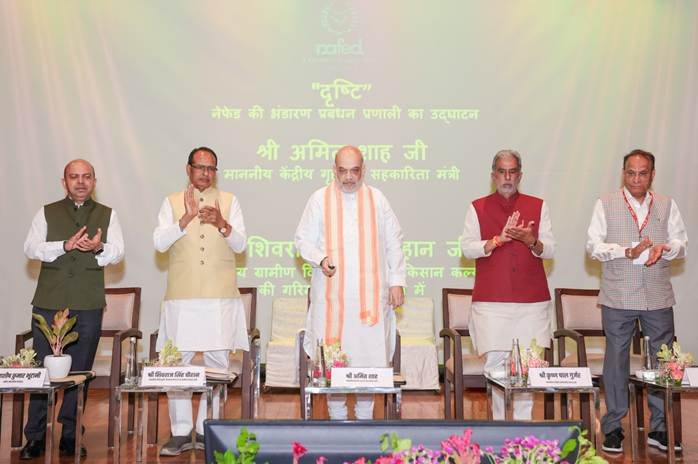
The launch event in New Delhi was attended by Union Minister of Agriculture & Farmers Welfare and Rural Development Shri Shivraj Singh Chouhan, Minister of State for Cooperation Shri Krishan Pal Gurjar, and other senior administrative officials. The initiative is part of the government’s broader digital transformation program for Indian agriculture, designed to secure fair and remunerative prices directly for producers.
Key Features of the NAFEX.in e-auction portal
- Middlemen Elimination: The platform creates a direct link between buyers and sellers, preventing local traders and middlemen from pocketing agricultural margins.
- Rapid Direct Payments: Proceeds from sales are scheduled to be deposited directly into the farmers’ bank accounts within 48 hours of transaction completion.
- Pulse Self-Reliance: NAFED and the National Cooperative Consumers’ Federation (NCCF) aim to procure every single grain of pulses directly from farmers within the next two years.
- Welfare Integration: A dedicated 1% of NAFED’s net profits will be directed toward a specialized scholarship fund for the higher education and career development of farmers’ children.
- Operational Transparency: Designed to replace slow, manual auctioning with real-time bidding, improving price discovery.
The Core Technology Behind NAFED’s Digital Reforms
The introduction of the NAFEX.in e-auction portal is expected to streamline how government agencies and private traders purchase bulk agricultural produce. Alongside the e-auction platform, Shri Amit Shah introduced three other key systems: DRISHTI, ERP, and NAFED Kalyan. Together, these tools form a digital monitoring and administrative suite for cooperative trade.
The *DRISHTI* system is designed for real-time tracking of procurement and inventory, reducing waste and delays at storage facilities. The new *ERP (Enterprise Resource Planning)* software integrates NAFED’s financial and physical operations into a single platform, helping to prevent financial mismanagement and improve auditing processes.
At the core of these technological reforms is the NAFEX.in e-auction portal, which manages bulk transactions with real-time tracking. This ensures that large buyers, including state governments and food processing industries, can participate in open bidding. This increased competition directly translates to better prices for farmers in local cooperatives.
The Financial Turnaround of NAFED
During his address, the Minister of Cooperation highlighted the financial recovery of NAFED over the past decade. In 2014, the organization was in a severe financial crisis and faced potential closure due to heavy debt. Strategic financial assistance and structural reforms under the Ministry of Cooperation helped restore NAFED as a profitable cooperative body.
NAFED has expanded its operations from basic procurement to organic farming, seed production, bio-fertilizer manufacturing, and international trade. These changes have substantially improved its financial performance. The implementation of clean governance practices and tools like the NAFEX.in e-auction portal have put NAFED back on a strong financial footing:
- Turnover Growth: Increased from Rs 20,000 crore to Rs 30,000 crore in the last three years, with a target of crossing Rs 50,000 crore in the next two years.
- Net Profit: Grown from Rs 139 crore to Rs 405 crore, with a current operational profit of Rs 500 crore.
- Net Worth: Witnessed an increase from Rs 358 crore to Rs 2,050 crore, indicating long-term financial stability.
For more updates on India’s cooperative reforms and policy directions, visit the official website of the Ministry of Cooperation.
Empowering Farmer Families: The NAFED Kalyan Initiative
A notable aspect of the launch was the introduction of *NAFED Kalyan*, a social security initiative for farming families. Under this program, NAFED has committed to earmarking 1% of its annual net profits to fund higher education scholarships for the children of registered farmers. This financial aid will help address the funding gaps that often prevent rural students from pursuing professional courses and career development training.
Shri Amit Shah emphasized that cooperatives must look beyond trade to actively support the social well-being of their members. By funding higher education, NAFED is investing in the long-term human capital of rural India, helping to make agriculture a more sustainable and socially secure profession.
Tributes to Dr. Syama Prasad Mookerjee on Balidan Diwas
At the beginning of his address, Union Home Minister Amit Shah paid tributes to Dr. Syama Prasad Mookerjee, the founder of the Bharatiya Jana Sangh, on his *Balidan Diwas* (June 23). He recalled Dr. Mookerjee’s contributions to India’s territorial and political integrity during the independence and partition era.
Shri Shah pointed out that Dr. Mookerjee played a key role during partition in ensuring that West Bengal remained an integral part of India. He also highlighted Dr. Mookerjee’s campaign against Article 370 in Jammu and Kashmir, where he advocated for “One Nation, One Constitution, One Head” and made the ultimate sacrifice in a Kashmir jail under suspicious circumstances. The Home Minister remarked that the abrogation of Article 370 stands as the realization of Dr. Mookerjee’s vision for a unified India.
Relevance for UPSC and State PSC Aspirants
For competitive exams, the launch of the NAFEX.in e-auction portal is highly relevant under agricultural and cooperative sectors. Additional policy analyses can be found in our National News Current Affairs section.
UPSC Civil Services Examination (CSE) Syllabus
- GS Paper III (Agriculture and Economics): E-technology in the aid of farmers, marketing of agricultural produce, issues related to direct and indirect farm subsidies, and minimum support prices (MSP).
- GS Paper I (Post-Independence Consolidation): Political history, post-independence consolidation, key leaders, and integration of states (Dr. Syama Prasad Mookerjee and Kashmir’s integration history).
State PSC (CGPSC/State Exams) Syllabus
- Paper on Indian Economy: Role of national agencies like NAFED and NCCF in procurement, direct benefit transfer (DBT) systems, and public distribution systems (PDS).
- Role of Cooperatives: The three-tier cooperative structure in India, rural banking, and digital initiatives in cooperative marketing.
Quick Revision Table: NAFED Reforms
| Key Parameter | Program / Reform Details |
|---|---|
| Primary Platform Launched | NAFEX.in e-auction portal |
| Launching Authority | Union Home Minister and Minister of Cooperation, Shri Amit Shah |
| Target Beneficiaries | Over 74 lakh registered farmers across India |
| Payment Window | Direct Bank Transfer (DBT) within 48 hours |
| Major Tech Suite | NAFEX.in, DRISHTI (Inventory Tracking), ERP (Enterprise Planning) |
| Welfare Initiative | NAFED Kalyan (1% profit allocated for farmer children’s scholarships) |
Frequently Asked Questions (FAQs)
1. What is the primary objective of the NAFEX.in e-auction portal?
The primary objective of the NAFEX.in e-auction portal is to provide a transparent, digital platform for bulk agricultural auctions, eliminating the influence of local middlemen and ensuring that market-discovered prices are paid directly to farmers.
2. How will the NAFEX.in e-auction portal benefit Indian farmers?
The portal allows farmers to sell their produce directly to bulk buyers. By integrating Direct Benefit Transfer (DBT) systems, the portal ensures that sale proceeds reach the farmers’ verified bank accounts within 48 hours of transaction completion.
3. What is the NAFED Kalyan initiative?
NAFED Kalyan is a social welfare initiative under which NAFED will allocate 1% of its annual net profits to fund higher education and career development scholarships for the children of registered farming families.
4. What is the target timeline for direct pulse procurement?
The Government of India has directed NAFED and NCCF to build the necessary grassroots infrastructure to procure every single grain of pulses directly from farmers within the next two years, supporting national self-reliance in pulse production.
5. Who was honored on Balidan Diwas during the launch event?
Union Home Minister Amit Shah paid tribute to Dr. Syama Prasad Mookerjee, the founder of the Bharatiya Jana Sangh, on his Balidan Diwas (June 23), noting his contributions to national unity and his campaign against Article 370.
Conclusion
The ongoing modernization of India’s cooperative sector, exemplified by the NAFEX.in e-auction portal, points to a future of more transparent, tech-driven agricultural trade. By addressing financial mismanagement, cutting out middlemen, and automating the auction process, NAFED has established a secure system for rural trade. Combined with welfare programs like the NAFED Kalyan scholarship, this digital shift shows that technological solutions can improve both economic returns and social welfare for farming families across India.