By Ishan Verma, Founder & Editor Theexamhub.in | June 25, 2026
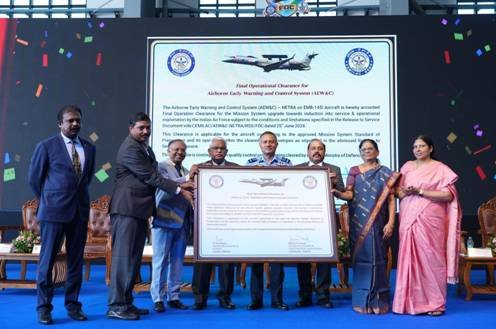
In a major boost to India’s airborne surveillance capabilities, the Defence Research and Development Organisation (DRDO) has officially handed over the certificate for the indigenous Netra AEW&C system FOC (Airborne Early Warning and Control system’s Final Operational Clearance) to the Indian Air Force (IAF). The formal ceremony, held in Bengaluru, marks a historic milestone in the nation’s journey toward self-reliance in advanced aerospace defense. Originally entering service under Initial Operational Clearance (IOC) in 2017, the Netra platform has now achieved its final operational clearance, validating its deployment readiness.
To help general readers and aspirants understand these defense terms, AEW&C stands for Airborne Early Warning and Control, which refers to radar systems designed to detect aircraft, missiles, and other incoming targets from the air. FOC stands for Final Operational Clearance, which is the final seal of approval indicating that a military system has passed all rigorous testing phases and is fully ready for active combat operations.
Key Benefits of the Netra AEW&C system FOC
- Airborne Battle Management: Integrates active radar arrays to provide 360-degree situational awareness and command control over battlespaces.
- Proven Combat Reliability: Extensively utilized in active combat operations, including Balakot air strikes and Operation Sindoor.
- Sovereign Tech Upgrades: Indigenous development allows the IAF to perform software modifications and add electronic-warfare suites without relying on foreign suppliers.
- Collaborative Design: Built by DRDO’s Centre for Air Borne Systems (CABS) in Bengaluru, alongside multiple Indian private sector partners.
- Strategic Independence: Reduces reliance on imports of foreign airborne warning systems, supporting national goals under *Aatmanirbhar Bharat*.
Understanding the Indigenous Netra Platform
The achievement of the Netra AEW&C system FOC establishes India as one of a select few countries with the capacity to design, develop, and integrate complex airborne early warning platforms. The Netra system is mounted on a modified Embraer ERJ 145 commercial regional jet, customized to carry DRDO’s active electronically scanned array (AESA) radar antenna on its fuselage.
The system provides secondary radar arrays, electronic support measures, and communication intelligence suites. These tools allow the aircraft to detect and track incoming threats—such as aircraft, cruise missiles, and drones—deep within hostile territory while directing friendly fighter jets during air defense operations. The integration of indigenous secure data links ensures that information is shared in real-time with ground-based command and control stations.
To read more about the scientific divisions managing airborne radar development, visit the official portal of the Defence Research and Development Organisation (DRDO).
Proven Battle-Tested Operational Reliability
The operational history behind the Netra AEW&C system FOC is supported by solid field performance. During the Bengaluru ceremony, Deputy Chief of the Air Staff Air Marshal Awadhesh Kumar Bharti highlighted the system’s performance during key security events, such as the Balakot strikes and Operation Sindoor.
Air Marshal Bharti explained that having an indigenous early warning system gives the armed forces the flexibility to adapt programs to meet changing battlefield conditions. This adaptability is highly useful during active conflicts, allowing the IAF to modify radar parameters and counter-measure systems locally. This independence is difficult to maintain when operating foreign platforms, which often require foreign contractor approval for sensitive modifications.
For more updates on active operations and aircraft deployments, visit the official Indian Air Force Portal.
The Bengaluru Handover Ceremony
During the Bengaluru ceremony for the Netra AEW&C system FOC, officials from the Air Force and DRDO gathered to celebrate the achievement. The event was attended by former Chief of the Air Staff Air Chief Marshal RKS Bhadauria (Retd), former DRDO Chairman Dr. S. Christopher, and Smt. P. Santhya, Director of the Centre for Air Borne Systems (CABS).
Dr. K. Rajalakshmi Menon, Director General of the Aeronautics Cluster at DRDO, described the challenges overcome during the flight-testing phase. She highlighted the role of system engineering in planning and executing the complex aerial trials needed to meet the Air Force’s operational standards. Dr. B. K. Das, Director General of the Electronics Cluster at DRDO, added that the cooperation among stakeholders was the primary driver behind the project’s completion, calling Netra a prime example of domestic technical capability.
Strategic Impact on India’s Defense Sector
The successful finalization of the Netra AEW&C system FOC indicates a shift in India’s defense planning. Historically, India relied on foreign suppliers for early warning platforms, including the Russian IL-76 aircraft equipped with Israeli Phalcon radars (AWACS). While these heavy platforms offer long-range capabilities, they are expensive to acquire and maintain.
The Netra platform offers a lighter, highly agile, and cost-effective alternative. Developing these complex airborne systems domestically has also helped build a robust local aerospace supply chain. Multiple Indian MSMEs and private defense firms have contributed components to the Netra platform, helping to build a domestic industrial base capable of supporting future aerospace projects.
Relevance for UPSC and State PSC Aspirants
For candidates preparing for civil services, the Netra AEW&C system FOC serves as a valuable case study. Candidates can find more defense analysis in our National News and Security Updates section.
UPSC Civil Services Examination (CSE) Syllabus
- GS Paper III (Science & Technology): Indigenization of technology and developing new technology; awareness in the fields of IT, Space, Computers, and robotics.
- GS Paper III (Security): Security challenges and their management in border areas; linkages of organized crime; role of the military and scientific divisions (DRDO, CABS).
State PSC (CGPSC/State Exams) Syllabus
- Science and Technology: Contribution of Indian scientists, development of indigenous research institutions, and national technology programs.
- Defense Sector Developments: Role of major defense units, state-supported research hubs, and industrial defense corridors.
Quick Revision Table: Netra AEW&C System
| Key Parameter | System and Project Details |
|---|---|
| Platform Status | Netra AEW&C system (Final Operational Clearance – FOC) |
| What it Stands For | Airborne Early Warning and Control System |
| Launching Authority | DRDO and Indian Air Force (IAF) |
| Initial Clearance (IOC) | Achieved in the year 2017 |
| Major Tech Suite | Stealth radars, active array sensors, and secure datalinks |
| Core Operational Use | Real-time airborne surveillance, battle management, and tracking |
Frequently Asked Questions (FAQs)
1. What is the primary objective of the NAFEX.in e-auction portal?
The primary objective of the NAFEX.in e-auction portal is to provide a transparent, digital platform for bulk agricultural auctions, eliminating the influence of local middlemen and ensuring that market-discovered prices are paid directly to farmers.
2. What does “Netra” stand for, and what is its role?
Netra is India’s indigenously developed Airborne Early Warning and Control (AEW&C) system. It acts as an airborne radar station, providing early warning of incoming threats, tracking enemy aircraft, and directing friendly fighters during battle.
3. What is the difference between IOC and FOC for the Netra system?
The Initial Operational Clearance (IOC), received in 2017, certified that the system met basic safe-to-fly requirements. The Final Operational Clearance (FOC) indicates that the system is fully mature, meeting all operational, tactical, and safety parameters required by the Indian Air Force.
4. Which organizations collaborated to develop the Netra AEW&C system?
The system was developed through close collaboration between the Defence Research & Development Organisation (DRDO), specifically the Centre for Airborne Systems (CABS), the Indian Air Force, and domestic public-private industries.
5. On which aircraft is the Netra AEW&C system integrated?
The Netra early warning radar and command electronics are integrated onto a modified Embraer ERJ 145 commercial regional jet engine platform.
Conclusion
The long-term development culminating in the Netra AEW&C system FOC shows India’s progress in advanced aerospace engineering. By successfully transitioning the platform from Initial Operational Clearance to Final Operational Clearance, DRDO and the IAF have established a reliable, battle-tested early warning system. This success serves as a model for future defense acquisitions, illustrating that long-term coordination between scientists, military end-users, and industrial manufacturers is essential for building a self-reliant defense sector.