By Ishan Verma, Founder & Editor Theexamhub.in | July 2, 2026
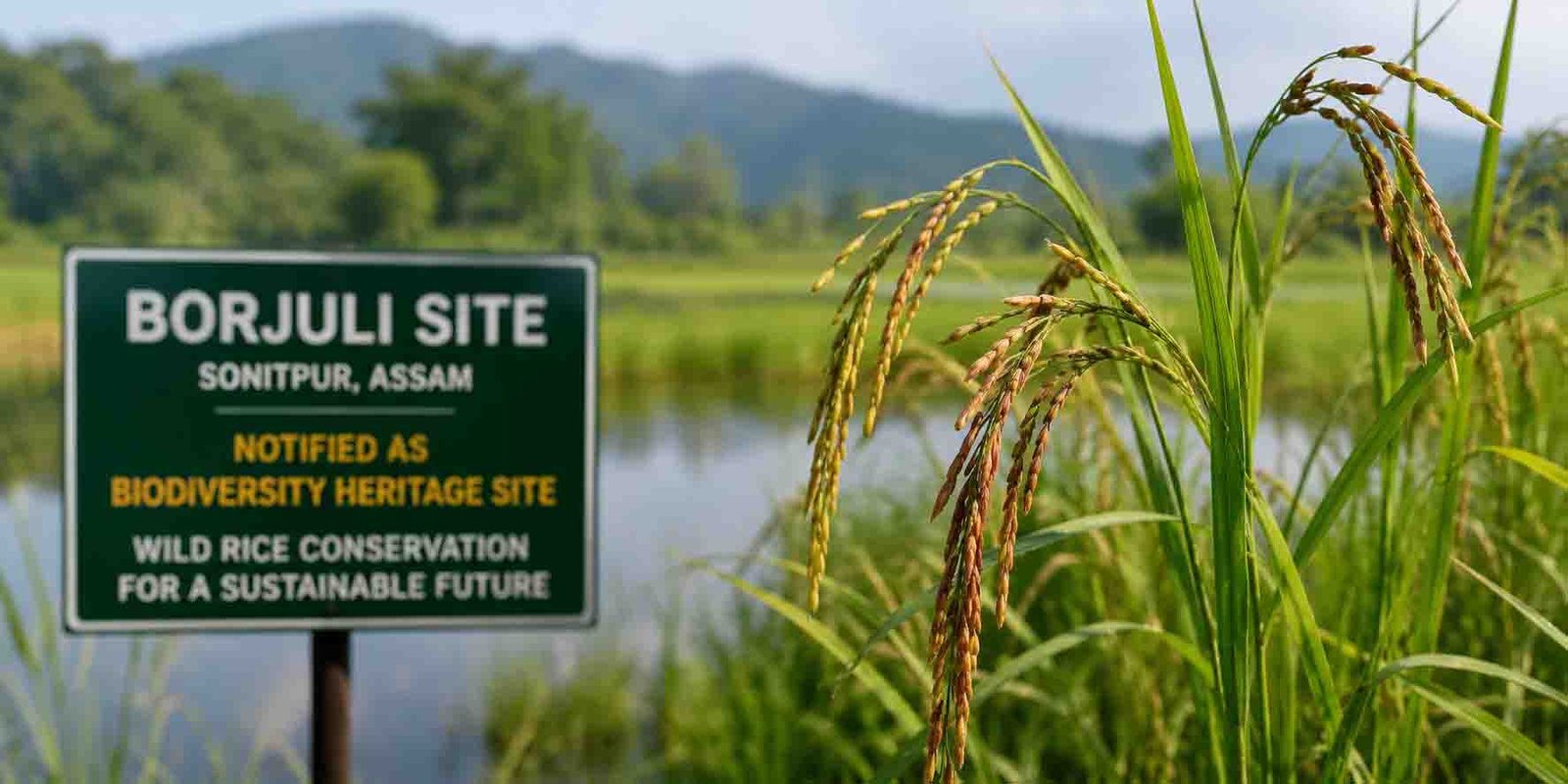
In a major milestone for agricultural research and ecological preservation, the Borjuli site in Assam’s Sonitpur district has been officially notified as a Biodiversity Heritage Site. This landmark recognition is a direct result of the highly successful Oryza rufipogon conservation Assam project, funded by the National Rainfed Area Authority (NRAA). Implemented since 2022, this collaborative initiative aims to protect the valuable genetic pool of Oryza rufipogon (wild rice), which is essential for developing climate-resilient crop varieties and securing long-term food security.
Declared under the provisions of the Biological Diversity Act, 2002, the new site will receive dedicated state-level protection. The project represents a successful model of in-situ conservation, where endangered species are protected within their natural habitats to preserve ecological systems and evolutionary processes.
Significance of the Oryza rufipogon conservation Assam Project
- Genetic Preservation: Focuses on protecting Oryza rufipogon, the wild ancestor of modern cultivated rice, preserving rare genes resistant to pests, droughts, and diseases.
- Biodiversity Heritage Site: The Borjuli site in Sonitpur has been officially declared a BHS, securing legal protection under the National Biodiversity Authority (NBA).
- Collaborative Implementation: Executed through close coordination between the ICAR–National Bureau of Plant Genetic Resources (ICAR-NBPGR), New Delhi, and the Assam State Biodiversity Board.
- Climate-Resilient Agriculture: Provides agricultural scientists with a natural gene bank to develop climate-resilient, high-yielding, and nutritionally superior rice varieties.
- Scalable Model: Establishes a framework for implementing similar in-situ conservation projects for other Crop Wild Relatives (CWR) across India.
The Scientific Importance of Oryza rufipogon
The focus of the Oryza rufipogon conservation Assam initiative is grounded in modern genetics. Oryza rufipogon, commonly known as wild rice or red-bearded rice, is the evolutionary ancestor of modern cultivated rice (Oryza sativa). Over thousands of years of domestic cultivation, modern rice varieties have lost much of their natural genetic diversity, making them highly vulnerable to changing weather patterns, water scarcity, and insect attacks.
Wild rice populations, however, survive in challenging environments, carrying rare genes that allow them to tolerate soil salinity, prolonged droughts, and heavy flooding. Preserving these Crop Wild Relatives (CWR) in their natural habitats allows scientists to study and utilize these adaptive genetic traits to breed resilient crop varieties, which are essential for maintaining stable food production amid changing global climates.
To read more about plant genetic resource collection and gene-bank management, visit the official website of the ICAR-National Bureau of Plant Genetic Resources (ICAR-NBPGR).
The Declaration of Borjuli as a Biodiversity Heritage Site
By expanding the Oryza rufipogon conservation Assam footprint, the Borjuli site has achieved a significant regulatory milestone. Under Section 37 of the Biological Diversity Act, 2002, state governments, in consultation with local bodies, can notify areas of unique ecological importance as Biodiversity Heritage Sites (BHS).
The BHS designation for Borjuli provides legal protection against commercial land use, unregulated tourism, and infrastructure developments that could disrupt the local wetland ecosystem where the wild rice thrives. This designation involves local panchayats and community members in the monitoring and management of the site, establishing a community-led model for ecological preservation.
To learn more about BHS guidelines and registered heritage zones in India, visit the official portal of the National Biodiversity Authority (NBA).
NRAA’s Leadership and Strategic Vision
During the administrative briefing of the Oryza rufipogon conservation Assam project, Dr. Chandra Shekhar Kumar, IAS, Chief Executive Officer of the National Rainfed Area Authority (NRAA), commended the research team. He emphasized that wild crop relatives are invaluable resources for national food security and called for replicating similar projects across diverse agro-climatic zones in India.
The coordination of the project was supported by key technical experts, including Dr. Pankaj Kumar Shah, Director (Agriculture & Horticulture), NRAA, and Dr. Anil Kumar Mishra, Technical Expert (Watershed Management), NRAA. Their combined efforts have helped bridge the gap between academic research and national agricultural policy, ensuring that genetic conservation remains a key component of sustainable watershed management.
Relevance for UPSC and State PSC Aspirants
For candidates preparing for civil services, the Oryza rufipogon conservation Assam case study is highly relevant under environmental law, agricultural development, and biodiversity conservation. Candidates can explore more policy updates in our National News and Policy Section.
UPSC Civil Services Examination (CSE) Syllabus
- GS Paper III (Environment & Ecology): Biodiversity and conservation, environmental impact assessment; Biological Diversity Act, 2002; Biodiversity Heritage Sites (BHS); in-situ versus ex-situ conservation methodologies.
- GS Paper III (Agriculture): Food security, technology in the aid of farmers, agricultural biotechnology, and developing climate-resilient crop varieties.
State PSC (APSC/CGPSC) Syllabus
- Regional Geography & Environment: Physical features of Assam, wetland ecosystems of Sonitpur district, state-level conservation initiatives, and the role of the Assam State Biodiversity Board.
- Socio-Economic Development: Integration of local communities in forest and biodiversity management, sustainable farming models, and traditional agriculture.
Quick Revision Table: Oryza rufipogon Conservation Assam
| Key Parameter | Project and Ecological Details |
|---|---|
| Project Name | Oryza rufipogon conservation Assam (In-situ Wild Rice Conservation) |
| Notified BHS Site | Borjuli Site, Sonitpur District, Assam, India |
| Funded By | National Rainfed Area Authority (NRAA), Ministry of Agriculture |
| Implementing Agencies | ICAR-NBPGR (New Delhi) and Assam State Biodiversity Board |
| Regulatory Framework | Section 37 of the Biological Diversity Act, 2002 |
| Target Species | Oryza rufipogon (wild progenitor of cultivated rice) |
Frequently Asked Questions (FAQs)
1. What is the newly approved Oryza rufipogon conservation Assam project?
It is an in-situ conservation and management initiative funded by the National Rainfed Area Authority (NRAA) to protect wild rice genetic resources (Oryza rufipogon) in their natural habitat in Assam.
2. Which site was declared a BHS under the Oryza rufipogon conservation Assam initiative?
The Borjuli site in the Sonitpur district of Assam has been officially notified as a Biodiversity Heritage Site (BHS) by the National Biodiversity Authority.
3. Why is Oryza rufipogon scientifically valuable?
Oryza rufipogon is the wild ancestor of cultivated rice. It holds rare, adaptive genes that provide natural resistance to environmental stressors like droughts, flooding, soil salinity, and pests, which are useful for crop breeding.
4. Under which law are Biodiversity Heritage Sites declared in India?
They are declared under Section 37 of the Biological Diversity Act, 2002, which empowers state governments to protect areas of high ecological and biological value in consultation with local bodies.
5. Which organizations collaborated to implement this conservation project?
The project was successfully executed through a partnership between the ICAR-National Bureau of Plant Genetic Resources (ICAR-NBPGR), New Delhi, and the Assam State Biodiversity Board.
Conclusion
The success of the Oryza rufipogon conservation Assam project shows the importance of protecting wild crop relatives to support future food security. By declaring the Borjuli site as a Biodiversity Heritage Site, the government has established a legally protected, community-led system to preserve valuable genetic resources. As agricultural systems face increasing pressures from climate change, preserving natural gene pools like wild rice remains essential for breeding resilient, high-yielding crop varieties and ensuring long-term agricultural sustainability.