By Ishan Verma | The Exam Hub | April 11, 2026
Somewhere in the dry deciduous forests of Kuno National Park, Madhya Pradesh, four tiny lives entered the world this week — and with them, an entire nation’s decades-long dream took a breath it had been holding since 2022.
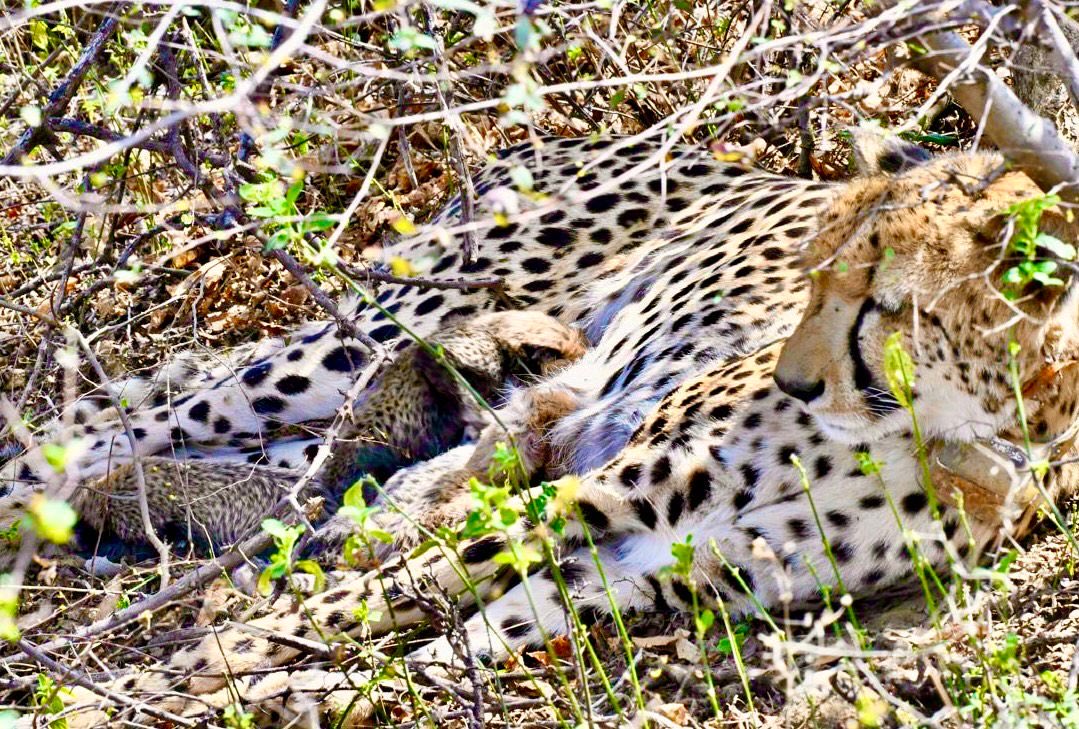
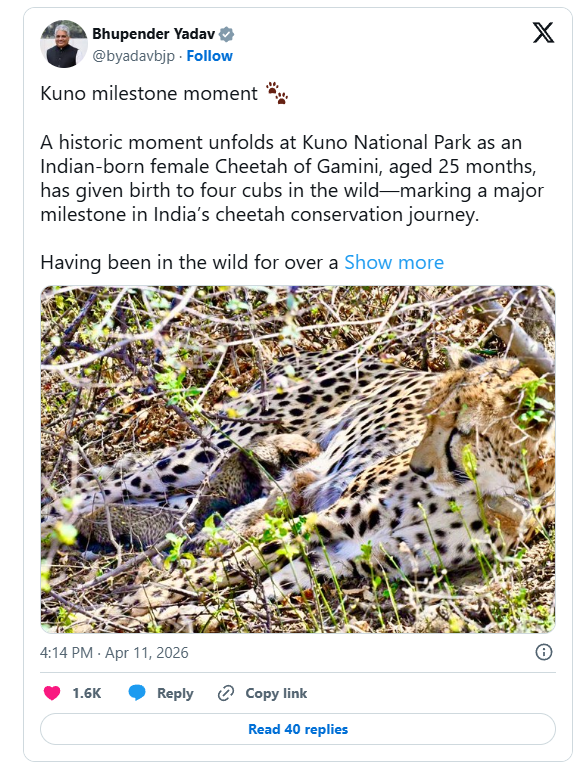
An Indian-born female cheetah, identified as KGP12, the second cub of the renowned cheetah Gamini, has given birth to four cubs in the wild at Kuno National Park. She is just 25 months old and has been roaming free in the wild for over a year. This is not a birth inside an enclosure. This is not a birth assisted by veterinarians. This is a wild birth — the first of its kind since India’s ambitious cheetah reintroduction programme began, and the first ever involving a cheetah that was born on Indian soil.
Union Minister for Environment, Forest and Climate Change, Shri Bhupender Yadav, hailed the development as a “milestone moment” for Kuno National Park and for India’s wildlife conservation efforts. In a social media post, he called it a proud moment for the nation — and he is right. Because what happened in those forests this week is not just a birth. It is proof.
Proof that cheetahs can survive in India. Proof that they can breed in India. Proof that the land they were once native to still has room for them.
The Story Behind the Cubs: Gamini’s Bloodline
To understand why these four cubs matter so much, you need to understand their mother.
KGP12 is the daughter of Gamini, one of the female cheetahs brought to India from South Africa and Namibia as part of the cheetah reintroduction programme. Gamini herself has been a star of the project — healthy, active, and productive. Her first litter produced cubs that survived and thrived in Indian conditions.
Now, her daughter — born on Indian soil, raised under Indian skies, fed by Indian prey — has done something her mother could not have done alone. She has given birth in the wild. Under natural conditions. Without human intervention.
This is the difference between importing hope and growing it.
When the first batch of cheetahs arrived in India in September 2022, carried in specially designed crates from the African savannah, the question on everyone’s mind was simple: Will they survive? Over the following months and years, some did. Some did not. The project faced criticism, setbacks, and heartbreaking losses. But the births kept coming — first in enclosures, then in semi-wild conditions.
And now, in the wild itself.
Why This Birth Is Different From Every Previous One
India’s cheetah reintroduction programme has seen cub births before. So what makes this one historic?
Three Firsts That Change Everything
| Achievement | Significance |
|---|---|
| First wild birth since the reintroduction began in 2022 | Previous births occurred in enclosures or managed conditions |
| First birth by an Indian-born female | KGP12 was born in India — she is not an imported cheetah |
| Four cubs born under natural conditions | No human assistance, no enclosure, fully wild |
This is the trifecta that conservationists have been waiting for. It means:
1.The ecosystem can support breeding — prey, territory, and climate are working
2.Second-generation cheetahs are adapting — an Indian-born female successfully mated and delivered in the wild
3.The population can sustain itself — if wild births continue, the cheetah population at Kuno can grow without relying on future imports
As Shri Bhupender Yadav noted, this achievement “represents a major step forward in achieving the core objectives of the project — ensuring survival and breeding of cheetahs under natural conditions in India.”
A Quick History: How Cheetahs Returned to India
For those unfamiliar with the journey, here is a brief timeline of one of the most ambitious wildlife conservation projects in Indian history.
| Date | Event |
|---|---|
| 1952 | Cheetahs declared extinct in India |
| 2009 | Idea of reintroduction first formally proposed |
| 2020 | Supreme Court of India approves the plan |
| September 2022 | First batch of 8 cheetahs arrives from Namibia |
| February 2023 | Second batch of 12 cheetahs arrives from South Africa |
| March 2023 | First cub born in India (in an enclosure) |
| 2023–2025 | Multiple births in managed conditions; some cheetahs released into the wild |
| April 2026 | KGP12 gives birth to four cubs in the wild — the first fully wild birth |
The cheetah (Acinonyx jubatus) was once found across India — from the grasslands of central India to the scrublands of Rajasthan. Mughal emperors kept them as hunting companions. But habitat loss, human-wildlife conflict, and prey depletion led to their extinction. The last confirmed sighting of a wild cheetah in India was in the 1940s in Chhattisgarh.
Bringing them back was never going to be simple. It required not just animals, but an entire ecosystem ready to receive them. Kuno National Park, with its mix of grasslands, dry forests, and adequate prey base, was selected as the site. And now, seven decades after the cheetah vanished from Indian soil, its grandchildren are being born free.
The Unsung Heroes: Wildlife Managers, Vets, and Field Staff
Behind every cub born at Kuno is a team of people who rarely make headlines.
Shri Bhupender Yadav made it a point to appreciate “the dedication and tireless efforts of wildlife managers, veterinarians, and field staff involved in the cheetah conservation programme.” These are the people who:
- Monitor cheetah movements through GPS collars day and night
- Track health indicators through regular veterinary check-ups
- Manage prey populations to ensure sufficient food
- Respond to emergencies — injuries, illnesses, territorial conflicts — at all hours
- Document every birth, death, movement, and behaviour for scientific research
They work in extreme heat, dense forests, and remote locations far from cities. They do not do it for fame. They do it because they believe that India’s wild places deserve their wild cats back.
This birth belongs to them as much as it belongs to KGP12.
What Happens Next: The Road Ahead for Kuno’s Cheetahs
Four cubs have been born. But the journey is far from over.
Immediate Challenges
- Survival rates: In the wild, cheetah cub mortality can be as high as 50–70% in the first year due to predation by leopards, hyenas, and other predators
- Mother’s health: KGP12 is young — just 25 months old. Raising four cubs in the wild is physically demanding
- Territory: Ensuring KGP12 has enough hunting territory without conflict with other cheetahs or predators
Long-Term Goals
- Establish a self-sustaining population of cheetahs at Kuno
- Expand to additional sites — other potential habitats have been identified in Rajasthan and other states
- Genetic diversity management — ensuring the small founding population does not lead to inbreeding
- Community engagement — building local support for cheetah conservation among villages surrounding Kuno
The Ministry of Environment, Forest and Climate Change has indicated that the success of wild births will be a key metric for evaluating the project’s long-term viability. KGP12’s four cubs have just provided the strongest evidence yet that the project is working.
The Bigger Picture: Why Cheetah Conservation Matters for India
Some may ask — why spend so much effort on bringing back an animal that disappeared 70 years ago? India has tigers, elephants, rhinos, and leopards. Why cheetahs?
The answer lies in ecological balance.
Cheetahs are grassland predators. They thrive in open landscapes — the same landscapes that are under threat from urbanisation, agriculture, and industrialisation. By protecting habitat for cheetahs, India is also protecting:
- Grassland ecosystems that support hundreds of other species
- Prey populations like chital, blackbuck, and nilgai
- Water resources and soil health in these regions
- Carbon sequestration through preserved grasslands
Cheetah conservation is not just about one species. It is about protecting an entire ecosystem that benefits millions of people and countless other animals.
Frequently Asked Questions
Which cheetah gave birth at Kuno National Park?
An Indian-born female cheetah identified as KGP12, the second cub of the cheetah Gamini, gave birth to four cubs in the wild at Kuno National Park.
How old is KGP12?
KGP12 is 25 months old — approximately two years and one month.
How many cubs were born?
Four cubs were born in the wild under natural conditions.
Is this the first wild birth of cheetahs in India?
Yes. This is the first recorded birth in the wild since the cheetah reintroduction programme began in 2022. It is also the first wild birth involving an Indian-born female cheetah.
Who announced the birth?
Shri Bhupender Yadav, Union Minister for Environment, Forest and Climate Change, announced the birth on social media, calling it a “milestone moment.”
When were cheetahs reintroduced to India?
The first batch of 8 cheetahs arrived from Namibia in September 2022. A second batch of 12 cheetahs arrived from South Africa in February 2023.
Where is Kuno National Park located?
Kuno National Park is located in Sheopur district, Madhya Pradesh, India.
Were cheetahs extinct in India?
Yes. Cheetahs were declared extinct in India in 1952. The last confirmed wild sighting was in the 1940s in Chhattisgarh.
Conclusion
Four cubs. Born free. In Indian soil. To an Indian-born mother.
It sounds simple. But behind those four small lives is seven decades of extinction, years of planning, months of debate, and countless hours of tireless fieldwork. KGP12 did not just give birth to cubs. She gave birth to hope — the kind of hope that says a species lost can be found again, that a mistake made can be corrected, and that India’s wild heart still beats.
As Shri Bhupender Yadav said, this is a proud moment for the nation. And it belongs to everyone — the ministers who championed the project, the scientists who planned it, the field staff who guard it, and the cheetahs who, against all odds, are making it work.
The cheetah is back. And now, it is here to stay.
For more updates on wildlife conservation, environment, and India’s biodiversity, bookmark TheExamHub.in.