Published on July 24, 2026 | By Ishan Verma, Editor, theexamhub.in
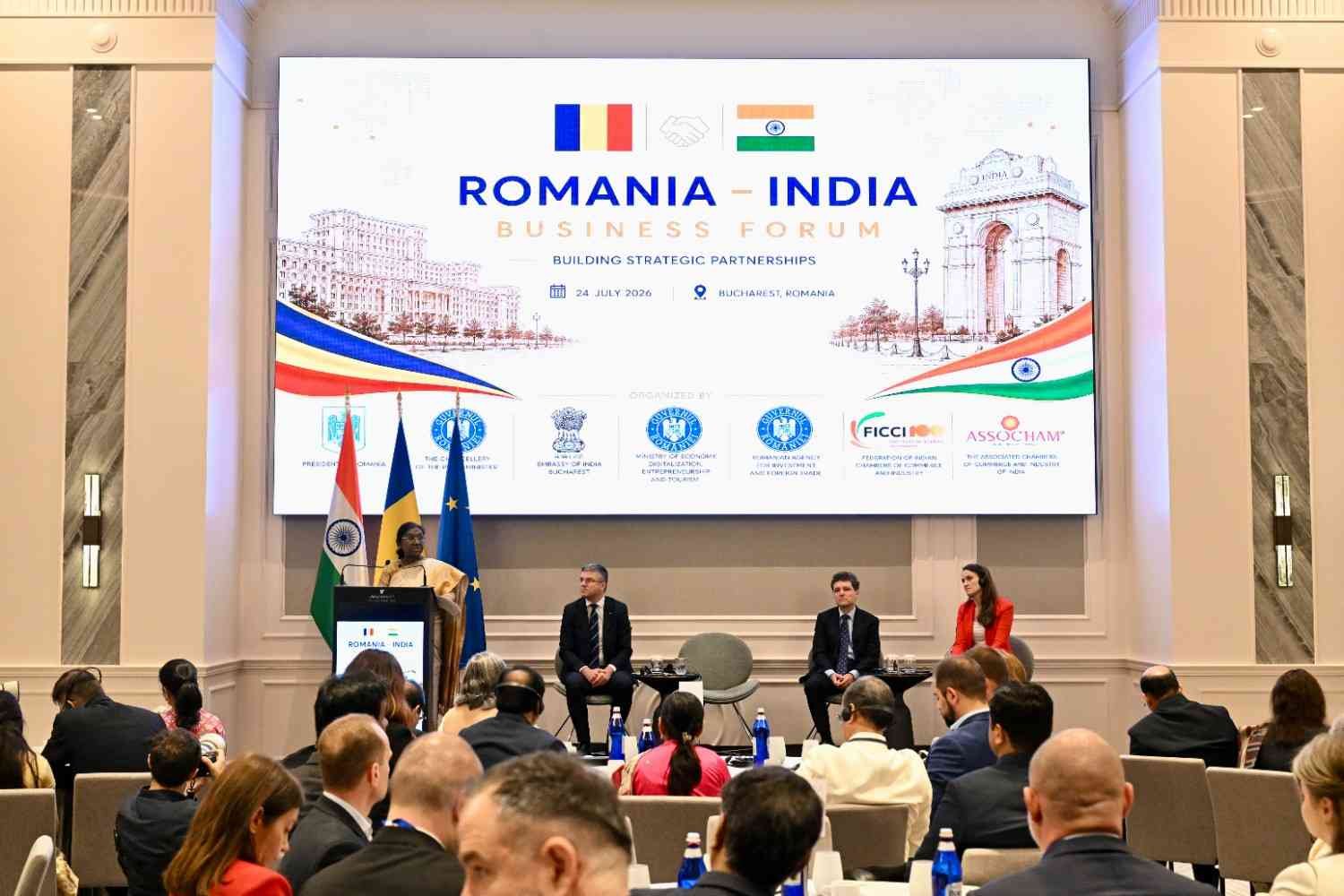
The President of India, Smt Droupadi Murmu, addressed the India–Romania Business Forum in Bucharest on July 24, 2026. Speaking in the presence of Romanian President H.E. Mr. Nicușor Dan, she highlighted that India’s journey toward “Viksit Bharat 2047” opens immense opportunities for global partnerships. The forum focused on expanding India-Romania Relations, utilizing the India-EU Free Trade Agreement, and strengthening collaboration in digital infrastructure, green energy, and logistics. President Murmu urged Romanian companies to actively join India’s expanding industrial growth story.
Quick Highlights
| Parameter | Details |
|---|---|
| Event Name | India–Romania Business Forum |
| Date of Event | July 24, 2026 |
| Venue | Bucharest, Romania |
| Key Dignitaries | Smt Droupadi Murmu (President of India) & H.E. Mr. Nicușor Dan (President of Romania) |
| Key Bilateral Agreement Focused | India-EU Free Trade Agreement (FTA) |
| Combined India-EU Market Size | Nearly 2 billion people | Economic size of ~$25 trillion |
| Core Sectors for Cooperation | DPI, Cybersecurity, Green Energy, Logistics, and Pharmaceuticals |
Did You Know? Romania is strategically located at the crossroads of Europe, serving as a gateway to the wider European Union market. This makes it a valuable geographic partner for Indian exporters.
Why in News?
On July 24, 2026, President Droupadi Murmu addressed a joint assembly of business leaders, government officials, and industry bodies in Bucharest. The address aimed to elevate India-Romania Relations by inviting Romanian firms to invest in India’s fast-growing economy. The meeting highlighted the importance of completing and implementing the India-EU Free Trade Agreement to build secure supply chains.
Background
India and Romania share a warm relationship that has gradually expanded from cultural exchanges to strategic economic cooperation. As India targets becoming a developed nation by 2047, diversifying trade with European nations is a key priority. Romania’s advanced industrial capabilities, skilled workforce, and geographic integration with the European Union (EU) make it a natural partner for India’s trade expansion plans.
Detailed Explanation: Areas of Cooperation and Strategic Impact
The business forum highlighted how both countries possess complementary strengths that can be matched to improve India-Romania Relations. President Murmu identified several core sectors where bilateral partnerships can yield commercial success:
1. The India-EU Free Trade Agreement (FTA)
The pending India-EU FTA represents a massive economic partnership, encompassing a combined market of nearly 2 billion people and a $25 trillion economy. Early and effective implementation of this agreement is crucial. It will provide a predictable trade environment, reduce tariff barriers, and create new opportunities for startups, MSMEs, and innovators in both regions.
2. Matching Tech and Digital Public Infrastructure (DPI)
India’s globally recognized Digital Public Infrastructure (DPI), thriving startup ecosystem, and leadership in information technology can benefit Romania’s tech sector. Romania possesses strong capabilities in software engineering, cybersecurity, research, and advanced technologies. Combining these strengths can lead to joint developments in secure digital services.
3. Energy Security and Green Transition
Both nations are committed to reducing carbon emissions and achieving energy security. There is immense scope for joint research and investments in solar power, wind energy, and hydrogen technologies. Additionally, Romania’s expertise in the chemical and fertilizer industries can help secure supply lines for India’s agricultural sector.
4. Infrastructure, Logistics, and Transportation
Developing robust transport channels is vital for growing bilateral trade. Opportunities exist for joint ventures in ports, railways, highways, logistics parks, and multi-modal transport networks. This integration will help Indian goods move smoothly into Eastern and Central Europe.
5. Pharmaceuticals and Agriculture
India’s low-cost, high-quality pharmaceutical manufacturing can help lower healthcare costs in Romania. Concurrently, collaborations in sustainable agriculture, food processing, and cold-storage technology can improve food security in both countries.
Key Features of India’s Investment-Friendly Reforms
To attract Romanian investments, President Murmu highlighted India’s structural business reforms:
- Simplified Taxation: Implementation of transparent, predictable, and simplified corporate tax structures.
- Production-Linked Incentives (PLI): Financial incentives aimed at boosting domestic manufacturing across key sectors.
- Ease of Doing Business: Digitized government approvals to reduce bureaucratic delays for foreign investors.
Benefits
Strengthening India-Romania Relations offers distinct benefits for both sides:
- Diversified Supply Chains: Reduces economic reliance on single-source supply networks, improving industrial resilience.
- Market Access: Provides Indian MSMEs and startups with a direct gateway to European markets through Romania.
- Technology Transfer: Facilitates sharing of advanced software engineering and cybersecurity expertise from Romania to India.
Challenges
Certain challenges must be addressed to maximize the impact of this partnership:
- Concluding the FTA: Resolving differences in intellectual property and labor standards to finalize the India-EU FTA.
- Logistical Distance: High shipping costs and complex transit routes between Indian ports and Eastern Europe.
- Regulatory Differences: Aligning Indian production standards with strict European Union health, safety, and environmental regulations.
Government Initiatives Supporting Trade
The Indian government has launched several schemes to aid global industrial partnerships. These include the “Make in India” initiative and specialized bilateral business desks designed to guide European investors. Diplomatic outreach programs, including high-level visits by the President, help build political trust, laying the foundation for private commercial contracts.
National and International Importance
Nationally, attracting foreign direct investment helps fund infrastructure projects required for the “Viksit Bharat 2047” plan. Internationally, deeper ties with Romania strengthen India’s geopolitical influence in Eastern Europe. This cooperation demonstrates that India is committed to building balanced, mutually beneficial economic relationships across the globe.
Latest Developments
Following the business forum, trade associations from both countries are expected to sign initial MoUs. These agreements will focus on establishing joint working groups in cybersecurity and food processing. These steps will help translate diplomatic statements into active business projects over the coming months.
Competitive Exam Section
UPSC Relevance
This topic is highly relevant for GS Paper II (Bilateral, regional and global groupings and agreements involving India and/or affecting India’s interests) and GS Paper III (Indian Economy, mobilization of resources, and growth).
Prelims Facts
- Nicușor Dan: Served as the President of Romania during the business forum on July 24, 2026.
- Viksit Bharat 2047: India’s national vision to become a developed nation by the 100th year of its Independence.
- Gateway Country: Romania’s geographic position near the Black Sea makes it a key transit route for EU trade.
Mains Perspective
Candidates can write about the strategic importance of Eastern Europe in India’s foreign trade policy. Discuss how concluding the India-EU FTA will help diversify India’s export markets and strengthen its global supply chains.
Important Data
- $25 Trillion: The approximate economic size of the combined India-EU market.
- 2 Billion: The combined population of the Indian and European Union markets.
- 2047: Target year for India to achieve its developed nation status.
Static GK Connection
- Capital of Romania: Bucharest.
- European Union (EU): A political and economic union of 27 member states, established in 1993, headquartered in Brussels, Belgium.
Possible Exam Questions
Prelims Question: Consider the following statements regarding India-Romania bilateral relations:
1. Romania acts as a crucial geographic gateway to the European Union market for Indian trade.
2. Both countries are currently working under the framework of a finalized and operational India-EU Free Trade Agreement.
Which of the statements given above is/are correct?
(a) 1 only | (b) 2 only | (c) Both 1 and 2 | (d) Neither 1 nor 2
Answer: (a) 1 only (The India-EU FTA is still being negotiated and is not yet fully operational).
One-Liner Revision Points
- President Droupadi Murmu addressed the India–Romania Business Forum in Bucharest on July 24, 2026.
- The forum focused on strengthening India-Romania Relations across digital, energy, and logistics sectors.
- The President highlighted the goal of “Viksit Bharat 2047” to attract Romanian technology collaborations.
- Romania offers valuable complementary strengths in cybersecurity, software engineering, and chemicals.
- The address highlighted the necessity of early implementation of the India-EU Free Trade Agreement.
Important Points to Remember
- India’s Digital Public Infrastructure (DPI) can complement Romania’s software engineering strengths.
- The India-EU FTA aims to deepen trade integration and build resilient supply chains.
- Simplified taxation and PLI schemes are designed to create an investor-friendly environment in India.
Frequently Asked Questions (FAQs)
Q1: What was the main purpose of the India-Romania Business Forum in 2026?
The forum aimed to strengthen India-Romania Relations by exploring mutual trade, investments, and technology collaborations to support India’s “Viksit Bharat 2047” vision.
Q2: Where was the business forum hosted?
The forum was hosted in Bucharest, the capital city of Romania, on July 24, 2026.
Q3: How does the India-EU Free Trade Agreement impact India-Romania Relations?
The FTA will provide a predictable trade environment, reduce tariff barriers, and create new opportunities for MSMEs and startups in both India and Romania.
Q4: Which sectors offer the highest potential for collaboration between the two nations?
The key sectors include Digital Public Infrastructure, cybersecurity, green energy, transport logistics, pharmaceuticals, and agricultural food processing.
Q5: What domestic reforms did President Murmu highlight to attract Romanian investors?
She highlighted India’s simplified corporate taxation, digitized approvals, and Production-Linked Incentives (PLI) designed to ease business operations.
Conclusion
Deepening India-Romania Relations is a strategic move that aligns with India’s long-term economic plans. By matching India’s digital capabilities with Romania’s advanced software engineering and industrial strengths, both countries can build highly resilient supply chains. This business forum highlights how diplomatic outreach can create active commercial partnerships, helping India move closer to its goal of Viksit Bharat by 2047.