Published on July 18, 2026 | By Ishan Verma, Editor, theexamhub.in
The Raksha Mantri, Shri Rajnath Singh, stated that Operation Sindoor demonstrates India’s up-to-date and robust defense readiness, driven by the government’s focus on Defence Indigenisation. Speaking in New Delhi on July 18, 2026, he highlighted that the operation showcased the effective deployment of advanced, home-grown weapons like the Akash Teer, Akash missile system, and BrahMos. This operation reflects a paradigm shift from import dependency to self-reliance, backed by rapid structural and industrial reforms over the past 12 years.
Quick Highlights
| Parameter | Details |
|---|---|
| Key Operation Highlighted | Operation Sindoor (Counter-terrorist tactical operation) |
| Indigenous Systems Used | Akash Teer, Akash Missile System, and BrahMos |
| FY 2025-26 Defence Production | Approximately ₹1.78 lakh crore (Up from ₹40,000 crore in 2014) |
| FY 2025-26 Defence Exports | Record high of ₹38,000 crore (Up from ₹686 crore in FY 2013-14) |
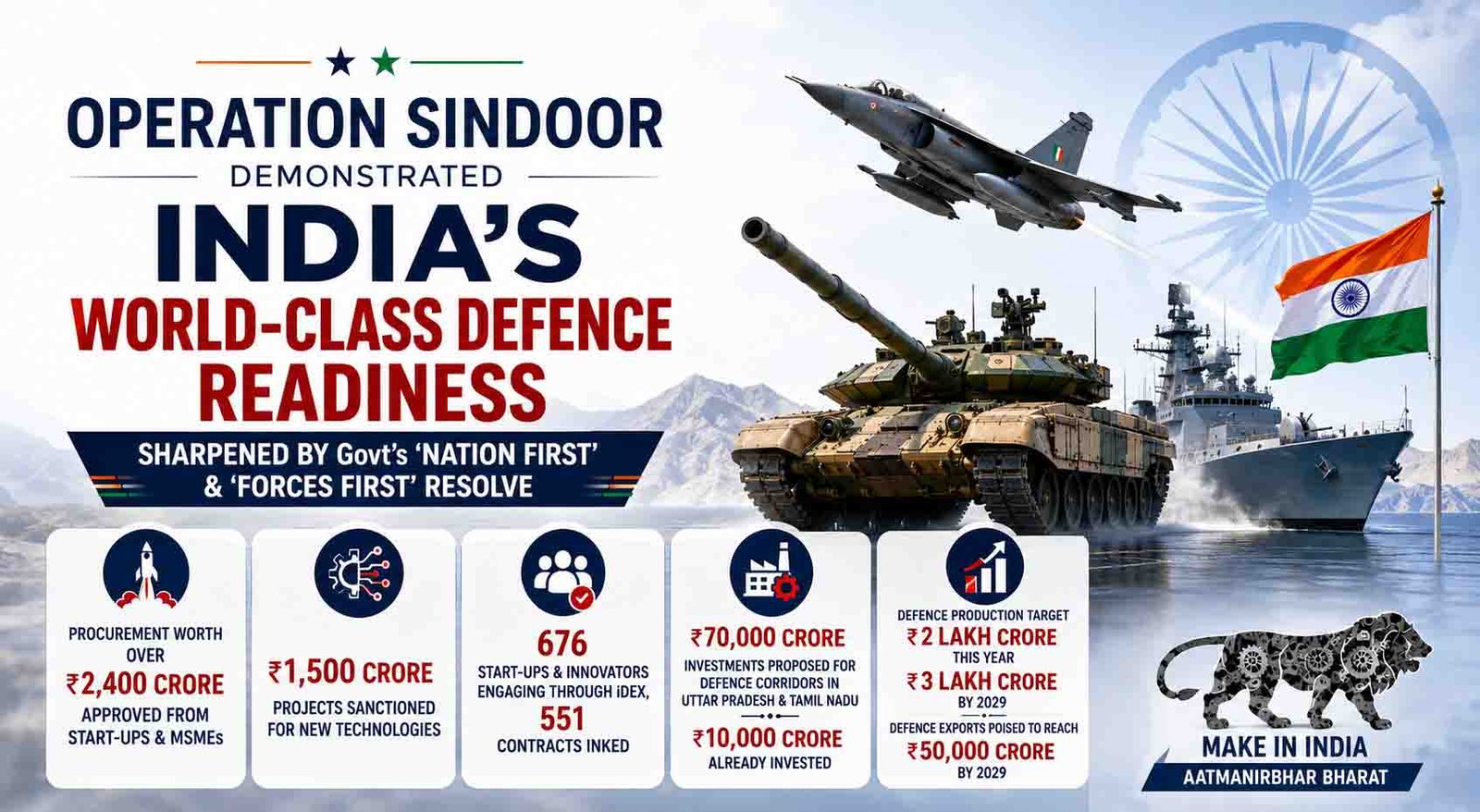
| Defence Production Targets | ₹2 lakh crore this year | ₹3 lakh crore by 2029 |
| Defence Export Target (2029) | ₹50,000 crore |
| Defence Industrial Corridors | Uttar Pradesh and Tamil Nadu (₹70,000 crore proposed investment) |
| Domestic Procurement Earmark | 75% of the modernization budget reserved for domestic industry |
Did You Know? The number of active defense startups in India has grown from only a few dozen in 2018 to more than 2,000 today, showing a rapid growth in private-sector defense innovation.
Why in News?
On July 18, 2026, Raksha Mantri Rajnath Singh addressed a defense gathering in New Delhi, praising the success of Operation Sindoor. He explained how the operation was a clear result of the government’s ‘Nation First’ and ‘Forces First’ policies. He used the occasion to share update figures on domestic production, startup procurements, and strategic export targets.
Background
For decades, India was one of the world’s largest importers of military hardware. This import dependency restricted India’s strategic autonomy during regional crises. To change this, the government introduced a major policy shift toward Defence Indigenisation in 2014. The goal was to build a local defense manufacturing ecosystem involving public shipyards, private players, MSMEs, and research labs.
Detailed Explanation of Key Defense Reforms
The transition toward self-reliance in defense has been driven by several key structural changes:
1. Positive Indigenisation Lists
To curb imports, the Ministry of Defence has issued five positive indigenisation lists for the armed forces, comprising 509 items. Additionally, five separate lists have been created for Defence Public Sector Undertakings (DPSUs), consisting of 5,012 items. These items can only be procured from domestic manufacturers. A new list is expected to be notified soon to further accelerate this process.
2. Funding Local Procurement
The government has earmarked 75% of its total defense modernization budget specifically for buying from Indian industries. Under the newly designed Defence Acquisition Procedure (DAP), priority is given to the “Buy Indian-Indigenously Designed, Developed & Manufactured” (Buy Indian-IDDM) category. A revised DAP is set to be released this year to streamline these acquisition channels.
3. Defence Industrial Corridors (DICs)
Two dedicated corridors have been set up in Uttar Pradesh and Tamil Nadu to build specialized defense industrial clusters. Out of the proposed ₹70,000 crore investment for these corridors, approximately ₹10,000 crore has already been invested. The UP Defence Industrial Corridor, in particular, has emerged as a successful manufacturing model, helping local firms integrate into global supply chains.
4. iDEX and Startup Ecosystem
The Innovations for Defence Excellence (iDEX) initiative, along with programs like iDEX Prime and the ADITI scheme, provides financial grants to startups and MSMEs. The government has approved over ₹2,400 crore in procurements from startups and MSMEs. Projects worth more than ₹1,500 crore have been sanctioned for developing emerging technologies like quantum tech, artificial intelligence, and robotics.
5. Corporatisation of the OFB
To improve output and quality, the outdated Ordnance Factory Board (OFB) was converted into seven public sector corporate entities. This structural change improved accountability, converting these public manufacturing units from loss-making bodies into profitable enterprises.
Key Features of India’s Defense Shift
- Transition to Producer: Moves India’s image from a buyer of foreign weapons to an exporter of advanced systems like the BrahMos missile.
- Integration of Startups: Over 676 startups are actively engaged through iDEX, with 551 contracts signed as of March 2026.
- Global Security Partner: Expands India’s defense diplomacy across the Indian Ocean Region and the wider Indo-Pacific.
Benefits
The push for Defence Indigenisation offers multiple strategic benefits:
- Strategic Autonomy: Producing weapons locally ensures that India is not dependent on foreign supply lines during security crises.
- Economic Growth: Keeping the modernization budget within the country creates jobs in local MSMEs and manufacturing units.
- Defense Diplomacy: Exporting indigenous equipment like the Akash missile system strengthens India’s ties with international partners.
Challenges
Several challenges remain in achieving complete self-reliance:
- Emerging Tech Integration: Keeping pace with rapid global developments in quantum computing, cyber warfare, and robotics.
- Sourcing Raw Materials: Reducing dependency on foreign imports for critical components like specialized semiconductors and alloys.
- Long Gestation Periods: Defense research and development naturally require years of testing before field deployment, creating transition delays.
Government Initiatives Promoting Defence Autonomy
The government’s strategy is supported by schemes like the Technology Development Fund (TDF) run by the DRDO. This fund supports MSMEs and startups in developing niche defense technologies. These research projects are backed by policy changes that simplify export procedures through the online Defence EXIM Portal, self-certification, and the Green Channel policy.
National and International Importance
Nationally, these reforms build public confidence in India’s ability to protect its borders without foreign reliance. Internationally, they position India as a key security provider in the Indo-Pacific. During his visits to Indonesia, Australia, and New Zealand, Prime Minister Modi highlighted these partnerships, expanding ties from BrahMos cooperation to industrial integrations.
Latest Developments
The Ministry of Defence is preparing to launch another Positive Indigenisation List. Concurrently, the private and public defense sectors are working to meet the target of exceeding ₹2 lakh crore in production this year. This pace supports the long-term goal of reaching ₹3 lakh crore in production and ₹50,000 crore in exports by 2029.
Competitive Exam Section
UPSC Relevance
This news is highly relevant for GS Paper III under Security (Security challenges and their management, indigenisation of technology, and developing new technology) and GS Paper II (Government policies and interventions).
Prelims Facts
- Operation Sindoor: A recent tactical operation showcasing modern, indigenous weapon systems like Akash Teer and BrahMos.
- iDEX: Innovations for Defence Excellence, launched in 2018 to foster innovation and technology development in Defence and Aerospace.
- ADITI Scheme: Focuses on developing critical and strategic defense technologies through startups.
Mains Perspective
Candidates can write about the transition of India’s defense sector from import reliance to self-reliance. Discuss how policy tools like positive indigenisation lists, private sector integration, and corporatisation of the OFB help protect national security interests.
Important Data
- ₹1.78 Lakh Crore: Annual defense production reached in FY 2025-26.
- ₹38,000 Crore: Total defense exports achieved in FY 2025-26.
- 75%: Modernization budget reserved for domestic procurement.
Static GK Connection
- DRDO: Defence Research and Development Organisation, established in 1958 under the Ministry of Defence, headquartered in New Delhi.
- Akash Missile System: A short-range surface-to-air missile (SRSAM) system developed by DRDO and produced by Bharat Dynamics Limited (BDL) to protect vulnerable areas from air attacks.
Possible Exam Questions
Prelims Question: With reference to Indian defense procurement, the term ‘Buy Indian-IDDM’ refers to which of the following?
(a) Acquiring defense equipment directly from foreign partners under government-to-government deals.
(b) Procurement of equipment designed, developed, and manufactured indigenously with minimum local content requirements.
(c) Sourcing military hardware through open global tenders without local production limits.
(d) Exclusively importing high-tech drone components for assembly in public shipyards.
Answer: (b) Procurement of equipment designed, developed, and manufactured indigenously with minimum local content requirements.
One-Liner Revision Points
- The successful execution of Operation Sindoor utilized indigenous systems like Akash Teer and BrahMos.
- India’s annual defense production reached a record high of ₹1.78 lakh crore in FY 2025-26.
- The target for annual defense production is set to exceed ₹2 lakh crore this year.
- Defence exports reached a record ₹38,000 crore in FY 2025-26, with a target of ₹50,000 crore by 2029.
- Uttar Pradesh and Tamil Nadu host India’s two active Defence Industrial Corridors.
Important Points to Remember
- Operation Sindoor serves as proof of India’s advanced technological warfare capabilities.
- Self-reliance prevents foreign powers from putting constraints on India’s strategic and military autonomy.
- Under iDEX, more than 551 innovation contracts have been signed as of March 2026.
Frequently Asked Questions (FAQs)
Q1: What is the significance of Operation Sindoor in the context of Defence Indigenisation?
Operation Sindoor showed that modern, complex tactical operations can be executed successfully using home-grown systems like Akash Teer, Akash, and BrahMos, verifying India’s domestic engineering capabilities.
Q2: What are Positive Indigenisation Lists?
They are official lists of military items and weapon systems that the armed forces and DPSUs are barred from importing, meaning they must be sourced from domestic manufacturers.
Q3: How much budget is reserved for domestic defense procurement?
The government has reserved 75% of the total defense modernization budget for procurement from domestic Indian industries.
Q4: Where are the two Defence Industrial Corridors located?
The two corridors are located in Uttar Pradesh and Tamil Nadu, with ₹70,000 crore in proposed investments to develop advanced manufacturing clusters.
Q5: What is the purpose of the iDEX initiative?
Innovations for Defence Excellence (iDEX) is a government program designed to foster innovation, research, and technology development in defense by supporting startups, MSMEs, and individual innovators.
Conclusion
The strategic shift in India’s defense sector is delivering clear results. By supporting domestic research, setting up dedicated industrial corridors, and utilizing initiatives like iDEX, India is reducing its historical reliance on foreign suppliers. As demonstrated by Operation Sindoor, the expansion of Defence Indigenisation protects India’s military autonomy and supports its long-term goals for Viksit Bharat by 2047.