By Ishan Verma, Founder & Editor Theexamhub.in | June 25, 2026
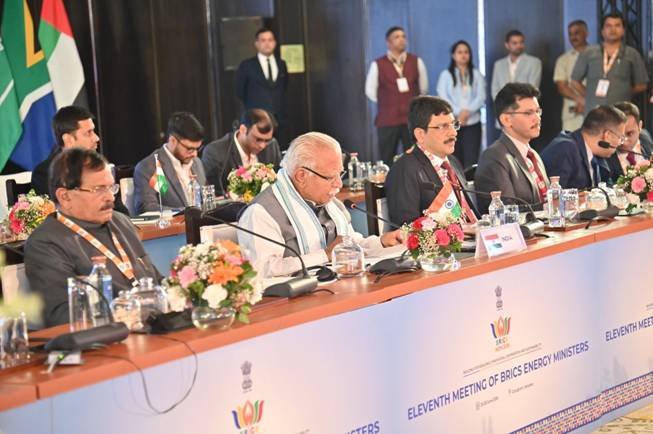
Under India’s presidential year, Gurugram successfully hosted the high-level BRICS Energy Ministers Meeting 2026 on June 25, 2026. Bringing together senior delegates, ministers, and international experts, this 11th ministerial conference concluded with major cooperative breakthroughs aimed at addressing global energy transitions. Under the overarching theme of “Building for Resilience, Innovation, Cooperation and Sustainability,” member nations adopted a unified joint communiqué that emphasizes national circumstances while launching a collaborative digital platform to enhance smart grids and storage infrastructure.
The conference highlighted the growing importance of collective action in balancing rapid economic development with climate responsibilities. Representatives from leading international bodies, including the International Solar Alliance (ISA), the Global Biofuels Alliance (GBA), and the New Development Bank (NDB), also participated to align global funding with local energy initiatives.
Key Takeaways of the BRICS Energy Ministers Meeting 2026
- Major Digital Launch: Unveiled the BRICS Digital Centre of Excellence for Smart Grids and Energy Storage to promote voluntary knowledge-sharing.
- Policy Consensus: Adopted the BRICS Guiding Principles on Smart Grids and Energy Storage, establishing a framework for digitally enabled power systems.
- Joint Communiqué: Finalized a comprehensive declaration that respects individual national circumstances and diverse energy pathways.
- Hydrogen Value Chains: Advanced cooperation on clean hydrogen standardizations, industrial applications, and future trade corridors.
- India’s Clean Energy Milestones: Showcased the host nation’s rapid transition, including crossing 540 GW of installed capacity, with non-fossil sources making up over half.
Core Priorities Guided by “Energy for All”
The agenda of the BRICS Energy Ministers Meeting 2026 was structured around the core Sanskrit principle of “सर्वेषां ऊर्जम्” (Energy for All). To achieve this, the representatives divided their policy discussions into three distinct priority areas:
- Energy Security and Sustainability: Focuses on building resilient energy systems, diversifying primary supply lines, securing critical minerals, and modernizing national grids.
- Energy Access and Equity: Centers on ensuring universal access to clean, affordable cooking fuels and electricity, while establishing affordable financing mechanisms for developing economies.
- Technology and Innovation: Emphasizes smart grid deployment, hydrogen supply chain development, artificial intelligence in grid management, and carbon capture technologies.
Major Deliverables of India’s Chairship 2026
A major outcome showcased at the BRICS Energy Ministers Meeting 2026 was the launch of the **BRICS Digital Centre of Excellence for Smart Grids and Energy Storage**. Available at brics-dcoe.global, the center operates under the BRICS Energy Research Cooperation Platform (ERCP) and will serve as a digital hub for sharing policy updates and implementing pilot programs across member nations.
Additionally, the ministers adopted the *BRICS Guiding Principles on Smart Grids and Energy Storage*, recognizing the importance of flexible power grids in integrating variable renewable energy. To support future technology transfers, the ministers also advanced the *BRICS Joint Report on Hydrogen Value Chains 2026* and updated the institutional rules of the ERCP to streamline joint research programs.
To learn more about international clean energy partnerships, visit the official website of the International Solar Alliance.
India’s Energy Transformation and Global Leadership
During his address at the BRICS Energy Ministers Meeting 2026, Union Minister of Power and Housing & Urban Affairs Shri Manohar Lal highlighted India’s role as the world’s third-largest producer and consumer of electricity. He noted that developing nations require adequate policy space and flexible timelines to meet their climate goals without compromising economic growth.
The Minister presented key data showing that India’s installed power capacity has reached nearly 540 GW, with non-fossil sources accounting for over half of the total. He highlighted the impact of the *PM Surya Ghar: Muft Bijli Yojana* in accelerating rooftop solar adoption, which has helped expand India’s solar capacity from 3 GW in 2014 to over 154 GW today.
Looking ahead, India has set targets to achieve over 400 GWh of energy storage capacity by 2032 and 100 GW of nuclear power capacity by 2047. The country has also achieved its target of 20% ethanol blending in transport fuels ahead of schedule, reinforcing its role in international partnerships like the Global Biofuels Alliance.
The Joint Communiqué: Prioritizing National Contexts
The joint communiqué adopted at the BRICS Energy Ministers Meeting 2026 reiterated that national energy security is the foundation of economic growth. The ministers emphasized that there is no single pathway to decarbonization. Instead, transition strategies must respect the domestic resource availability, economic structures, and developmental priorities of each member nation.
The document also called for increased international funding and lower capital costs for clean energy projects in emerging economies. The ministers also supported continuing youth engagement, noting the successful hosting of the *BRICS Youth Energy Summit* during India’s presidency, and expressed support for China as it prepares to assume the BRICS Chairship in 2027.
Relevance for UPSC and State PSC Aspirants
For competitive exams, the outcomes of the BRICS Energy Ministers Meeting 2026 provide useful material for papers on international relations, environmental policy, and economic planning. Candidates can access more analytical resources in our National News and Policy Section.
UPSC Civil Services Examination (CSE) Syllabus
- GS Paper II (International Relations): Bilateral, regional, and global groupings involving India and affecting India’s interests (BRICS plurilateral cooperation).
- GS Paper III (Environment & Economy): Infrastructure (Energy), conservation, environmental pollution and degradation, and environmental impact assessment of energy transitions.
State PSC (CGPSC/State Exams) Syllabus
- Socio-Economic Development: State-level clean energy targets, rural electrification, and implementation of centralized programs like PM Surya Ghar Yojana.
- Energy Resources: India’s primary energy mix, non-fossil energy generation, and the growth of renewable power transmission systems.
Quick Revision Table: BRICS Energy Ministers Meeting
| Key Parameter | Meeting Details & Decisions |
|---|---|
| Event Name | BRICS Energy Ministers Meeting 2026 (11th Ministerial) |
| Host City & Date | Gurugram, Haryana, India; June 25, 2026 |
| Meeting Theme | “Building for Resilience, Innovation, Cooperation and Sustainability” |
| Indian Delegation Lead | Shri Manohar Lal, Union Minister of Power |
| Major Tech Platform | BRICS Digital Centre of Excellence for Smart Grids (brics-dcoe.global) |
| Next Chairship | People’s Republic of China (2027) |
Frequently Asked Questions (FAQs)
1. Where was the 11th BRICS Energy Ministers Meeting 2026 held?
The 11th BRICS Energy Ministers Meeting 2026 was held in Gurugram, Haryana, under India’s BRICS Chairship 2026.
2. What was the main digital outcome of the BRICS Energy Ministers Meeting 2026?
The key digital outcome was the official launch of the **BRICS Digital Centre of Excellence for Smart Grids and Energy Storage** (brics-dcoe.global), designed to facilitate technical knowledge sharing and collaborative research among member nations.
3. What are India’s long-term energy storage and nuclear power targets?
India aims to establish over 400 GWh of battery and pumped energy storage capacity by 2032 and scale its nuclear power generation capacity to 100 GW by the year 2047.
4. What core Sanskrit concept guided the ministerial discussions?
The discussions were guided by the Energy Track theme “सर्वेषां ऊर्जम्”, which translates to “Energy for All,” focusing on equitable and sustainable energy distribution.
5. Which country will hold the BRICS Chairship in 2027?
The BRICS Chairship and the subsequent Energy Ministers’ Meeting will be hosted by the People’s Republic of China in 2027.
Conclusion
Ultimately, the BRICS Energy Ministers Meeting 2026 serves as a strong indicator of how developing economies are balancing climate action with industrial growth. By establishing clear guiding principles for smart grids and launching a dedicated digital center of excellence, the BRICS nations have taken practical steps toward shared technical development. As India hands over the chairship to China for 2027, the outcomes achieved in Gurugram provide a solid foundation for collaborative, resilient, and inclusive energy planning across the Global South.