By Ishan Verma, Founder & Editor Theexamhub.in | July 6, 2026
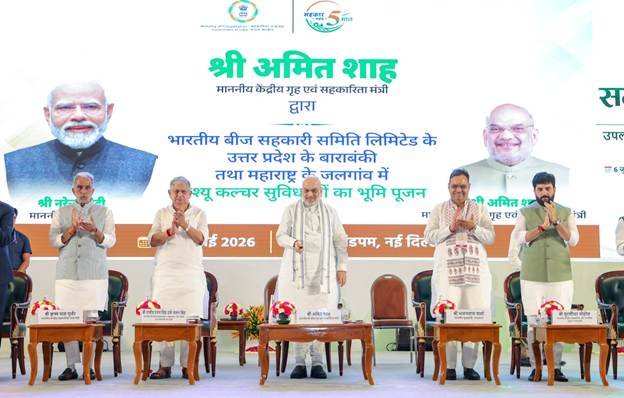
Marking a defining milestone in India’s cooperative movement, Union Home and Cooperation Minister Shri Amit Shah addressed the high-profile Ministry of Cooperation 5th Foundation Day celebration in New Delhi. Established on July 6, 2021, by Prime Minister Narendra Modi, the ministry has over the past five years successfully revitalized a sector that supports over 30 crore citizens and 8.5 lakh cooperative institutions. Minister Shah launched several digital, educational, and operational initiatives designed to transform the cooperative ecosystem into a modern, competitive, and highly transparent pillar of a prosperous India by 2047.
The anniversary celebration was attended by several senior leaders, including Union Minister of Fisheries, Animal Husbandry and Dairying Shri Rajiv Ranjan Singh, Rajasthan Chief Minister Shri Bhajan Lal Sharma, and State Cooperation Ministers. The event demonstrated how centralized policy reforms can support state-level agricultural and dairy cooperatives without interfering with state jurisdictions.
Major Initiatives Launched at the Ministry of Cooperation 5th Foundation Day
- Tribhuvan Sahkari University: A dedicated national cooperative university designed to produce professionally trained managers for banks, dairies, and agricultural cooperatives.
- 50,000 e-PACS Milestone: Officially transformed 50,000 Primary Agricultural Credit Societies (PACS) into fully digitized “e-PACS,” implementing electronic auditing and transparent ledger systems.
- Sahakar CBS and Sahakar Sahayogi: Launched a centralized core banking platform (Sahakar CBS) and a conversational AI assistant (Sahakar Sahayogi) for Urban Cooperative Banks.
- Gomay Cooperative Society: Established a multi-state cooperative to promote a 100% circular economy in the dairy sector through organic fertilizers and dung management.
- Seed Systems Strengthening: Signed a strategic MoU between Bharat Beej Sahakari Samiti Limited (BBSSL) and ICAR to establish tissue culture labs and high-quality seed distribution centers.
Professionalizing Cooperatives: Tribhuvan Sahkari University
A central highlight during the Ministry of Cooperation 5th Foundation Day address was the formal announcement of **Tribhuvan Sahkari University**. For decades, the cooperative sector has faced challenges related to administrative stability, inconsistent appointments, and a lack of standardized training. This newly established university seeks to address these issues by producing skilled professionals trained in cooperative banking, dairy science, agricultural marketing, and logistics.
The university’s curriculum is designed to introduce professional management across all levels of the cooperative sector, from primary village-level societies (PACS) to apex national institutions. By establishing merit-based, transparent recruitment processes managed by trained professionals, the initiative aims to eliminate administrative corruption, improve operational efficiency, and build public trust in cooperative banking networks.
To read more about national cooperative guidelines and registered societies, visit the official website of the Ministry of Cooperation Portal.
Digitizing the Grassroots: 50,000 e-PACS and CSC Integration
The operational milestones shared on the Ministry of Cooperation 5th Foundation Day included the successful computerization of grassroots credit societies. Out of NAFED and state-level PACS, over 50,000 have been successfully declared as **e-PACS**, having their entire ledger and transaction history digitized at a cost of Rs 3,000 crore funded by the central government. This allows for automated “e-audits” and real-time financial tracking, making local cooperative activities highly transparent.
Additionally, 55,000 PACS have been integrated as Common Service Centers (CSCs), allowing them to provide over 300 digital services directly to rural citizens. Through these centers, villagers can book railway tickets, register births and deaths, apply for central welfare schemes, and access crop insurance. Over 39,000 PACS have also been converted into PM Kisan Samriddhi Kendras, and 600 operate as Jan Aushadhi Kendras, turning these traditional credit societies into multi-service rural business hubs.
Advanced Technological and Agricultural Initiatives
Adding to the tech-driven reforms of the Ministry of Cooperation 5th Foundation Day, the government unveiled several financial platforms developed under the National Urban Co-operative Banks and Credit Societies Federation (NUCFDC). These include *Sahakar CBS*, a centralized core banking software that enables smaller urban cooperative banks to access modern digital payment systems, and *Sahakar Sahayogi*, an AI-powered conversational platform designed to assist cooperative bank employees and customers.
On the agricultural front, the *Gomay Cooperative Society Limited* was launched to promote a circular economy in the dairy sector. This cooperative will manage animal waste, produce organic fertilizers as alternatives to chemical DAP, and generate renewable energy at the village level. To support seed conservation, a strategic MoU was signed between *Bharat Beej Sahakari Samiti Limited (BBSSL)* and the Indian Council of Agricultural Research (ICAR) to establish advanced tissue culture facilities in states like Uttar Pradesh and Maharashtra, helping to deliver high-yielding, uniform seeds to farmers.
For details on rural development loans and state cooperative grants, explore the official National Cooperative Development Corporation (NCDC) Portal.
Tributes to Dr. Syama Prasad Mookerjee on His 125th Birth Anniversary
Celebrating the Ministry of Cooperation 5th Foundation Day also coincided with paying tribute to Dr. Syama Prasad Mookerjee, the founder of the Bharatiya Jana Sangh, on his 125th birth anniversary (July 6). Shri Amit Shah recalled Dr. Mookerjee’s contributions to maintaining the territorial integrity of India during Partition, noting his campaigns that ensured West Bengal and Assam remained part of the Indian Union.
The Cooperation Minister highlighted Dr. Mookerjee’s campaign against Article 370 in Jammu & Kashmir under the slogan “One Nation, One Constitution, One Head.” He remarked that the abrogation of Article 370 under the leadership of Prime Minister Narendra Modi represents the realization of Dr. Mookerjee’s vision. The government has decided to celebrate his 125th birth anniversary year with educational programs and commemorative events across the country.
Relevance for UPSC and State PSC Aspirants
For candidates preparing for competitive exams, the study of the Ministry of Cooperation 5th Foundation Day outcomes is highly useful under governance, cooperative federalism, and agricultural reforms. Additional policy analyses can be found in our National News and Policy Analysis section.
UPSC Civil Services Examination (CSE) Syllabus
- GS Paper II (Governance): Multi-state cooperative societies, cooperative federalism (balancing central policy-making with state-level administrative domains under the 97th Constitutional Amendment), and e-governance applications in rural development.
- GS Paper III (Agriculture & Economy): Rural banking infrastructure, crop procurement, sustainable agricultural inputs (organic fertilizers, bio-DAP), food storage infrastructure, and financial inclusion.
State PSC (GPSC/CGPSC/RPSC) Syllabus
- Regional Economy and Cooperatives: Three-tier cooperative banking structures, primary dairy cooperatives (like Amul/Saras models), and agricultural marketing federations.
- Administrative Training: Use of specialized training institutes, digital audit systems in local bodies, and public service delivery through digitized PACS.
Quick Revision Table: Ministry of Cooperation 5th Foundation Day
| Key Parameter | Details of National Cooperative Reforms |
|---|---|
| Event Celebrated | Ministry of Cooperation 5th Foundation Day |
| Ministry Establishment | July 6, 2021 (by Prime Minister Narendra Modi) |
| Key Academic Launch | Tribhuvan Sahkari University (for professional cooperative management) |
| Digital Milestones | 50,000 PACS digitized as e-PACS; 55,000 PACS activated as CSCs |
| Banking Technology | Sahakar CBS (Core Banking) and Sahakar Sahayogi (AI Assistant) |
| Welfare & Agriculture | Gomay Cooperative (Dairy Circular Economy), BBSSL-ICAR Seed MoU |
Frequently Asked Questions (FAQs)
1. What was the significance of the Ministry of Cooperation 5th Foundation Day?
The Ministry of Cooperation 5th Foundation Day on July 6, 2026, marked five years since the establishment of the independent ministry. The event served as a platform to launch several digital, financial, and educational reforms, including Tribhuvan Sahkari University, e-PACS databases, and AI banking assistants.
2. Which major university was announced on the Ministry of Cooperation 5th Foundation Day?
The government announced the establishment of **Tribhuvan Sahkari University**, which will offer specialized professional training in cooperative banking, dairy management, and agricultural logistics to improve administrative standards across the sector.
3. How many PACS have been digitized as part of these reforms?
Under the computerization project, over 50,000 Primary Agricultural Credit Societies (PACS) have been digitized into **e-PACS**, allowing for electronic bookkeeping and automated financial audits.
4. What are Sahakar CBS and Sahakar Sahayogi?
They are digital platforms developed under NUCFDC for Urban Cooperative Banks. Sahakar CBS is a centralized core banking software, while Sahakar Sahayogi is a conversational AI assistant designed to help bank staff and customers.
5. Who was honored on his 125th birth anniversary during the event?
The Union Cooperation Minister paid tribute to Dr. Syama Prasad Mookerjee, the founder of the Bharatiya Jana Sangh, on his 125th birth anniversary, noting his contributions to national unity and the integration of West Bengal and Kashmir.
Conclusion
The achievements showcased during the Ministry of Cooperation 5th Foundation Day prove that structural and technological reforms can successfully modernize traditional agricultural and credit systems. By digitizing 50,000 village credit societies, establishing a dedicated national cooperative university, and introducing AI-driven banking tools, the Ministry of Cooperation has built a stable foundation for the rural economy. As these digital and administrative systems expand, the cooperative sector is positioned to play a key role in promoting sustainable, transparent, and inclusive development across the country.