By Ishan Verma, Founder & Editor Theexamhub.in | July 5, 2026
In a major validation of technological innovation in public health, the Indian Council of Medical Research (ICMR) has secured the prestigious ICMR-MINDS Gold Award 2026 at the National Awards for e-Governance. Conferred under “Category 2: Innovation by Use of AI and Other New Age Technologies for Providing Citizen-Centric Services,” the national honor recognizes the platform’s role in digitizing and decentralizing mental healthcare delivery. Instituted by the Department of Administrative Reforms and Public Grievances (DARPG), the award highlights how AI-driven tools are empowering frontline healthcare workers to deliver standardized mental healthcare across rural India.
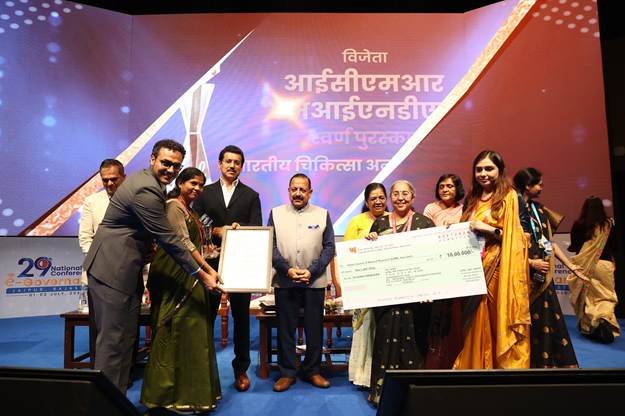
The award was presented during the 29th National Conference on e-Governance (NCeG) 2026, held in Jaipur, Rajasthan. The national platform has successfully demonstrated how technology can bridge the gap in specialist medical services, establishing a sustainable, scalable model for public health management.
Core Pillars of the ICMR-MINDS Gold Award 2026
- National Recognition: Awarded the Gold Medal under Category 2 for outstanding innovation in providing citizen-centric services using modern technologies.
- The MINDS Framework: Stands for Mental Health Integration with Non-Communicable Diseases, focused on screening, assessing, and managing mental and substance-use disorders in primary care.
- Task-Shifting Model: Leverages a Clinical Decision Support System (CDSS) to shift basic mental health diagnostics from psychiatrists to non-specialist frontline providers.
- Bidirectional Referral: Implements a structured referral and back-referral pathway, allowing stable patients to receive local follow-up care while reserving specialists for complex cases.
- Multi-State Implementation: Currently operating across seven Indian states through seven premier medical and research institutions.
The Core Technology: Clinical Decision Support and Task-Shifting
The significance of the ICMR-MINDS Gold Award 2026 lies in its practical solution to a major public health challenge: the severe shortage of mental health specialists in rural and semi-urban India. To address this, the ICMR-MINDS platform uses a digital Clinical Decision Support System (CDSS) to facilitate “task-shifting.” This process allows trained, non-specialist frontline healthcare providers (such as community health officers, general nurses, and ANMs) to perform standardized mental health screenings and assessments.
A major technology highlight praised during the ICMR-MINDS Gold Award 2026 evaluation is the platform’s ease of use in the field. The software features standardized digital screening workflows, role-based clinical guidance, offline operational capability, and multilingual user interfaces. It also includes gamified features to maintain high engagement levels among health workers, and real-time administrative dashboards that allow district health authorities to monitor service delivery and patient progress.
To read more about India’s public health research programs and technological innovations, visit the official website of the Indian Council of Medical Research (ICMR).
Presentation at the 29th National Conference on e-Governance
At the 29th National Conference where the ICMR-MINDS Gold Award 2026 was presented, Union Minister of State for Personnel, Public Grievances & Pensions, Dr. Jitendra Singh, handed over the trophy. The ceremony in Jaipur was attended by senior administrative leaders, including Col. Rajyavardhan Rathore, Minister for IT and Communication, Government of Rajasthan; Shri V. Srinivas, Chief Secretary, Government of Rajasthan; and Smt. Nivedita Shukla Verma, Secretary, DARPG.
The DARPG awards are designed to recognize innovative public service delivery systems that leverage modern technologies like artificial intelligence to improve citizen services. The ICMR-MINDS platform was commended for its ability to reduce patient dropouts, improve treatment adherence, and lower the financial burden on rural families by reducing the need to travel to distant tertiary care hospitals.
To explore the guidelines and previous winners of the national e-governance awards, visit the official portal of the Department of Administrative Reforms and Public Grievances (DARPG).
Implementing Network and Multi-State Partnerships
Reacting to the ICMR-MINDS Gold Award 2026 announcement, Dr. Rajiv Bahl, Secretary, Department of Health Research, and Director General of ICMR, reaffirmed the council’s commitment to using data-driven, scalable technology to solve complex public health challenges. He thanked the state health departments and collaborating research institutions for their efforts in implementing the platform on the ground.
The program is currently being implemented across seven states through seven collaborating premier institutions:
- Assam: All India Institute of Medical Sciences (AIIMS), Guwahati
- Gujarat: Gujarat Institute of Mental Health (GIMH), Ahmedabad
- Haryana: AIIMS, New Delhi
- Karnataka: St. John’s Medical College, Bengaluru
- Madhya Pradesh: AIIMS, Bhopal
- Odisha: AIIMS, Bhubaneswar
- Punjab: Postgraduate Institute of Medical Education and Research (PGIMER), Chandigarh
Relevance for UPSC and State PSC Aspirants
For candidates preparing for civil services, the ICMR-MINDS Gold Award 2026 serves as an informative case study on social justice, public healthcare, and digital governance. Candidates can find more health policy updates in our National News and Governance Updates section.
UPSC Civil Services Examination (CSE) Syllabus
- GS Paper II (Governance & Social Justice): E-governance applications, models, successes, and limitations; citizen charters, transparency, and accountability; issues relating to the development and management of the Social Sector/Services relating to Health.
- GS Paper III (Technology): Awareness in the fields of IT, computers, and robotics (AI application in healthcare); developing new technology and indigenization of technology in public health.
State PSC (GPSC/CGPSC) Syllabus
- Human Resource Development & Health: State-level healthcare delivery systems, maternal and mental healthcare programs, and the role of information technology in rural medical networks.
- Administrative Governance: Implementation of national awards schemes, e-governance initiatives by the state departments, and public welfare administration.
Quick Revision Table: ICMR-MINDS Project
| Key Parameter | Project and Award Details |
|---|---|
| Honor Conferred | ICMR-MINDS Gold Award 2026 (DARPG e-Governance) |
| Award Category | Category 2: Innovation by Use of AI & New Age Tech for Citizen Services |
| Award Venue & Date | 29th National Conference on e-Governance, Jaipur; July 1–2, 2026 |
| Primary Target | Integrating mental health screening with non-communicable diseases (NCDs) |
| Core Technology | Clinical Decision Support System (CDSS) for task-shifting to frontline workers |
| Participating States | Assam, Gujarat, Haryana, Karnataka, Madhya Pradesh, Odisha, and Punjab |
Frequently Asked Questions (FAQs)
1. What is the primary significance of the ICMR-MINDS Gold Award 2026?
The ICMR-MINDS Gold Award 2026 recognizes the project’s success in using artificial intelligence and digital decision-support systems to integrate standardized mental healthcare within primary health center networks across India.
2. Under which category was the ICMR-MINDS Gold Award 2026 presented?
The award was presented under “Category 2 — Innovation by Use of AI and Other New Age Technologies for Providing Citizen-Centric Services,” instituted by the Department of Administrative Reforms and Public Grievances (DARPG).
3. What does “task-shifting” mean in the context of this project?
Task-shifting is the process of moving routine clinical duties—such as initial mental health screening, basic assessments, and follow-up care—from scarce specialist psychiatrists to trained, non-specialist frontline healthcare providers using digital decision tools.
4. What technology supports the ICMR-MINDS platform?
The platform is supported by an AI-enabled Clinical Decision Support System (CDSS) that offers standardized digital workflows, role-based clinical guidance, offline operational capability, and multilingual interfaces.
5. Which seven states are currently implementing the ICMR-MINDS program?
The program is actively being implemented across seven states: Assam, Gujarat, Haryana, Karnataka, Madhya Pradesh, Odisha, and Punjab, in coordination with premier regional medical research institutes.
Conclusion
The success recognized by the ICMR-MINDS Gold Award 2026 proves that digital technology can be adapted to solve complex, systemic challenges in public healthcare. By using an AI-supported decision tool to safely shift basic mental health screenings to frontline community health workers, ICMR has designed a practical way to expand access to care. As state health departments work to scale this model, the integration of mental health screening with non-communicable disease management serves as a valuable example of how technology can help deliver affordable, standardized, and high-quality healthcare across rural India.