Published on July 16, 2026 | By Ishan Verma, Editor, theexamhub.in
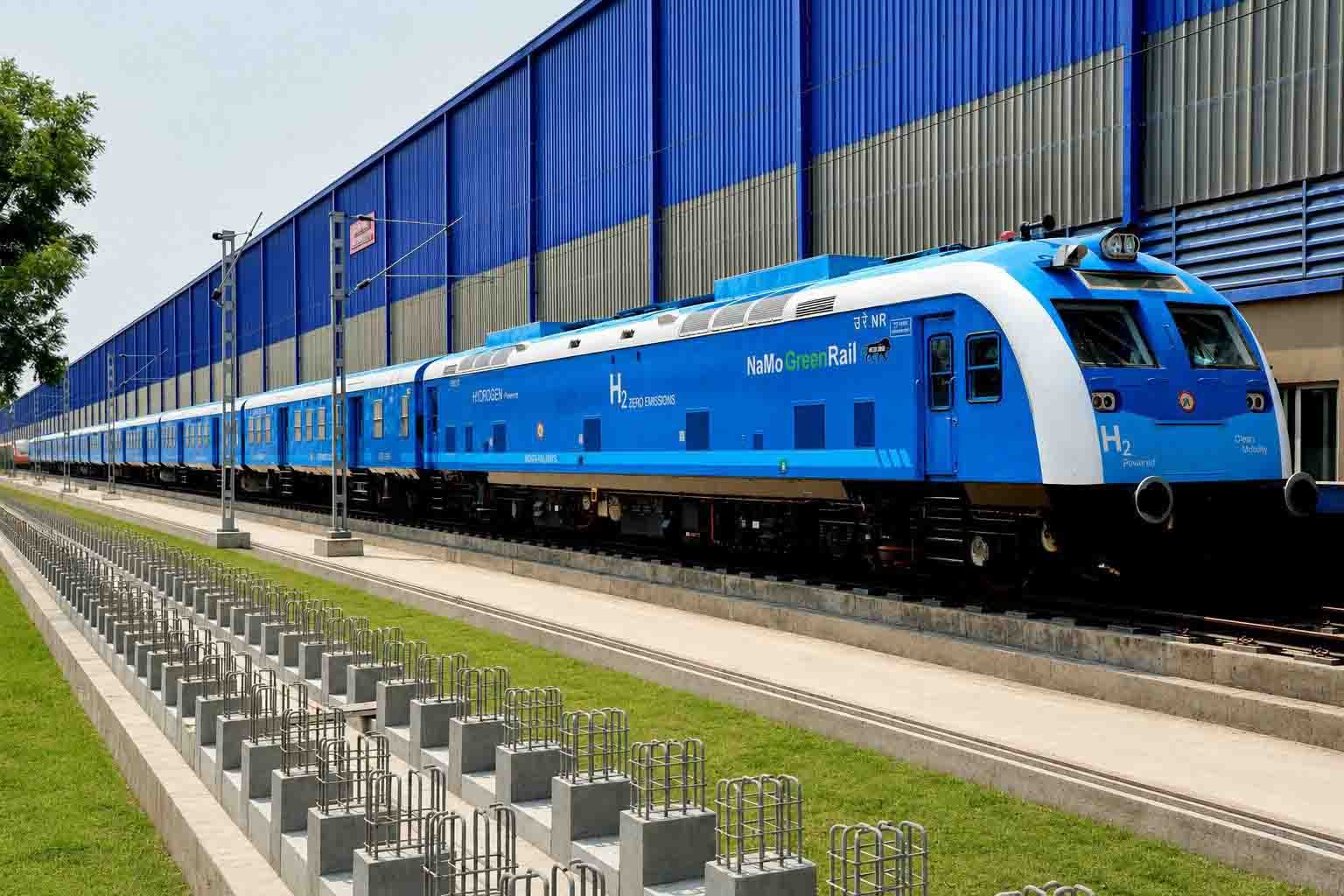
Indian Railways is preparing to launch the nation’s first Hydrogen Fuel Cell Train, generating its own clean electricity onboard. Notified on July 16, 2026, this modern 10-coach passenger trainset has a capacity of around 2,600 passengers. It will initially run on the 89 km Jind–Sonipat section in Haryana. By generating electricity through an electrochemical reaction, the train emits only water vapor and heat, marking a significant step toward net-zero rail mobility.
Quick Highlights
| Parameter | Details |
|---|---|
| Train Type | Hydrogen Fuel Cell Trainset (Zero-Emission) |
| Capacity | Around 2,600 passengers |
| Configuration | 10 coaches (2 Driving Power Cars, 8 Trailer Coaches) |
| Initial Route | Jind–Sonipat section, Northern Railway (89 km) |
| Maximum Speed | Design speed: 110 kmph | Operational speed: 75 kmph |
| Integration Partner | M/s Medha Servo Drives & Integral Coach Factory (ICF) |
| Refuelling Facility | Jind, Haryana (Production, compression at 500 bar, dispensing at 350 bar) |
| Safety Approvals | PESO compliant & certified by TÜV SÜD, Germany |
Did You Know? While most global hydrogen passenger trains consist of only two or three coaches for regional routes, India’s new train is configured with 10 coaches. This represents a major advancement in the scalability of high-capacity green rail transport.
Why in News?
On July 16, 2026, Indian Railways announced the readiness of India’s first operational Hydrogen Fuel Cell Train. The train has successfully passed several performance and safety tests, making it ready for public service. Along with the rolling stock, Indian Railways established the country’s largest railway hydrogen refuelling facility at Jind, Haryana, to support the new train services.
Background
Indian Railways has undergone a massive energy transition over the past decade. With over 99% of Broad Gauge routes now electrified, the network has significantly reduced its reliance on imported diesel. The introduction of the Hydrogen Fuel Cell Train represents the next phase of this ecological journey. It allows the railway network to run clean, self-powered trains on routes where overhead electric lines are not practical or historically preserved.
Detailed Explanation: How the Hydrogen Train Works
Unlike standard trains, a Hydrogen Fuel Cell Train generates its own electricity onboard through chemical reactions rather than drawing power from overhead wires. It carries a miniature power plant in the form of a Proton Exchange Membrane (PEM) fuel cell.
The train carries pressurized hydrogen gas in dedicated storage cylinders. Inside the fuel cell, this hydrogen combines with oxygen pulled from the surrounding atmosphere. This electrochemical reaction produces electricity, which powers the traction motors to move the wheels. The only direct by-products of this entire process are water vapor and heat, with no direct carbon emissions.
The trainset is configured with two Hydrogen Driving Power Cars (DPCs) at each end and eight Trailer Coaches in between. Each DPC houses the PEM fuel cells, lithium iron phosphate (LFP) auxiliary batteries, and high-pressure hydrogen storage tanks. The two power cars produce 1,200 kW of power each, allowing the train to reach speeds of up to 110 kmph.
The Hydrogen Refuelling Infrastructure at Jind
To support the daily operations of the new train, Indian Railways built a state-of-the-art refuelling facility at Jind. This integrated green hydrogen system works in three distinct stages:
- On-site Production: Hydrogen is produced through water electrolysis, splitting water molecules into hydrogen and oxygen using clean electricity.
- Compression: The produced gas is compressed to 500 bar to store a larger volume of fuel in smaller, dedicated ground tanks.
- Simultaneous Dispensing: Dual dispensers refuel both Driving Power Cars at a regulated pressure of 350 bar, minimizing turnaround time.
Key Features of the Train
The trainset possesses several features designed for modern commuter lines:
- Indigenous Integration: Built under the leadership of Indian Railways, with RDSO formulating technical specifications and Medha Servo Drives integrating the power systems.
- Advanced Safety: Employs multi-layer detection systems to identify leaks, heat anomalies, flames, or smoke within seconds.
- High Passenger Capacity: Accommodates approximately 2,600 passengers, proving that green technology can serve crowded commuter routes.
Benefits
The deployment of this technology offers major benefits. Operating a Hydrogen Fuel Cell Train completely eliminates local tailpipe emissions, improving air quality in populated regions. It also helps Indian Railways progress toward its goal of becoming a Net-Zero Carbon Emitter by 2030. Furthermore, developing this tech indigenously strengthens India’s industrial capabilities in advanced mechanical engineering.
Challenges
Several hurdles must be addressed as the program expands. Generating green hydrogen requires a continuous supply of clean electricity, which can be expensive. Designing secure storage systems for highly flammable hydrogen gas also requires advanced engineering. Additionally, setting up specialized refuelling stations nationwide requires significant capital investment.
Multi-Layer Safety Systems
Since hydrogen is highly flammable, safety was integrated into every layer of the train’s design. The systems operate on the “defence in depth” principle, utilizing several independent safety measures:
- Continuous Ventilation: Active air circulation prevents hydrogen from accumulating in enclosed areas if a minor leak occurs.
- Automatic Shut-off: The control software can immediately isolate the hydrogen storage tanks without human intervention if it detects pressure anomalies.
- Loco Pilot Protections: The cabin includes real-time health monitoring screens and an emergency mode to move the train to a safe location.
- Third-Party Certification: The entire design complies with ISO 19880 safety standards and was certified by TÜV SÜD, Germany.
Government Initiatives Supporting the Project
This project is a critical component of India’s National Green Hydrogen Mission, which aims to make the country a global hub for producing and exporting green hydrogen. By testing these systems in public transit, the government is validating the commercial viability of hydrogen technologies. It also supports India’s international commitments to lower carbon emissions under the Paris Agreement.
National and International Importance
Nationally, this train establishes a template for replacing diesel locomotives on non-electrified routes. Internationally, it places India in an elite group of nations deploying hydrogen rail technology. While other countries like Germany and Japan run smaller regional trains, India’s 10-coach trainset proves that hydrogen can power high-capacity transport networks.
Latest Developments
Before receiving clearance to carry passengers, the trainset underwent rigorous load box trials, radio frequency testing, oscillation trials, and emergency braking distance tests. Following these successful evaluations, Indian Railways is now exploring the deployment of hydrogen technology on heritage routes, starting with the scenic Kalka–Shimla railway line.
Competitive Exam Section
UPSC Relevance
This topic is relevant for GS Paper III under Infrastructure (Railways), Energy (Renewable Energy and Green Hydrogen), and Science & Technology (Indigenisation of Technology).
Prelims Facts
- Fuel Cell Type: Proton Exchange Membrane (PEM) fuel cell.
- Trial Route: Jind–Sonipat section of Northern Railway (89 km).
- Safety Certification: Evaluated by TÜV SÜD, Germany, and approved by the Petroleum and Explosives Safety Organisation (PESO).
Mains Perspective
Candidates can write about the role of green hydrogen in achieving India’s Net-Zero goals. Highlight how integrating renewable energy into public transport networks addresses both economic and environmental challenges.
Important Data
- 75 kmph: Target operational speed on the Jind-Sonipat section.
- 3,000 kg: Storage capacity of the hydrogen refuelling facility at Jind.
- 2,600: Passenger capacity of the 10-coach trainset.
Static GK Connection
- National Green Hydrogen Mission: Launched in 2023 with the goal of reaching a green hydrogen production capacity of 5 MMT (Million Metric Tonnes) per annum by 2030.
- RDSO: Research Designs and Standards Organisation, the research and development wing of the Ministry of Railways, headquartered in Lucknow.
Possible Exam Questions
Prelims Question: Consider the following statements regarding the newly introduced Hydrogen Fuel Cell Train in India:
1. It produces electricity onboard using a Proton Exchange Membrane fuel cell.
2. Carbon dioxide and water vapor are the only direct by-products of this process.
Which of the statements given above is/are correct?
(a) 1 only | (b) 2 only | (c) Both 1 and 2 | (d) Neither 1 nor 2
Answer: (a) 1 only (Water vapor and heat are the only by-products; there are no carbon emissions).
One-Liner Revision Points
- India’s first Hydrogen Fuel Cell Train will run on the Jind-Sonipat route in Haryana.
- The train has been integrated by Medha Servo Drives and built using domestic designs.
- It can carry up to 2,600 passengers across its 10-coach configuration.
- The hydrogen refuelling facility at Jind is the largest railway hydrogen plant in India.
- The fuel system has been certified for safety by Germany’s TÜV SÜD and approved by PESO.
Important Points to Remember
- The train generates its own electricity through a clean chemical reaction of hydrogen and oxygen.
- A multi-layer safety system protects passengers by detecting gas leaks and heat instantly.
- Green hydrogen is produced on-site at Jind using water electrolysis.
Frequently Asked Questions (FAQs)
Q1: What is a Hydrogen Fuel Cell Train?
It is a zero-emission train that generates its own electricity onboard by combining stored hydrogen with oxygen from the air inside a fuel cell, emitting only water and heat.
Q2: On which route will India’s first hydrogen train operate?
The train will operate on the 89 km Jind–Sonipat section of the Northern Railway in Haryana.
Q3: Is the hydrogen fuel cell train safe for passengers?
Yes, the train features multi-layer safety systems, leak detectors, continuous ventilation, and automatic shut-offs. The design is PESO-approved and certified by TÜV SÜD, Germany.
Q4: How does the Jind refuelling station produce hydrogen?
The facility uses water electrolysis, splitting water molecules into hydrogen and oxygen using electricity, creating an integrated green hydrogen ecosystem.
Q5: How does India’s hydrogen train compare globally?
While global pilot projects typically run small 2-to-3 coach regional trains, India’s train is a 10-coach configuration designed to carry 2,600 passengers, proving high-capacity scalability.
Conclusion
The introduction of the Hydrogen Fuel Cell Train marks an important step toward cleaner public transport. By combining advanced fuel systems with multi-layer safety designs, Indian Railways has demonstrated that high-capacity rail can run with zero emissions. As this green technology matures, it will help India move closer to its sustainable development and net-zero targets.