By Ishan Verma, Founder & Editor Theexamhub.in | June 25, 2026
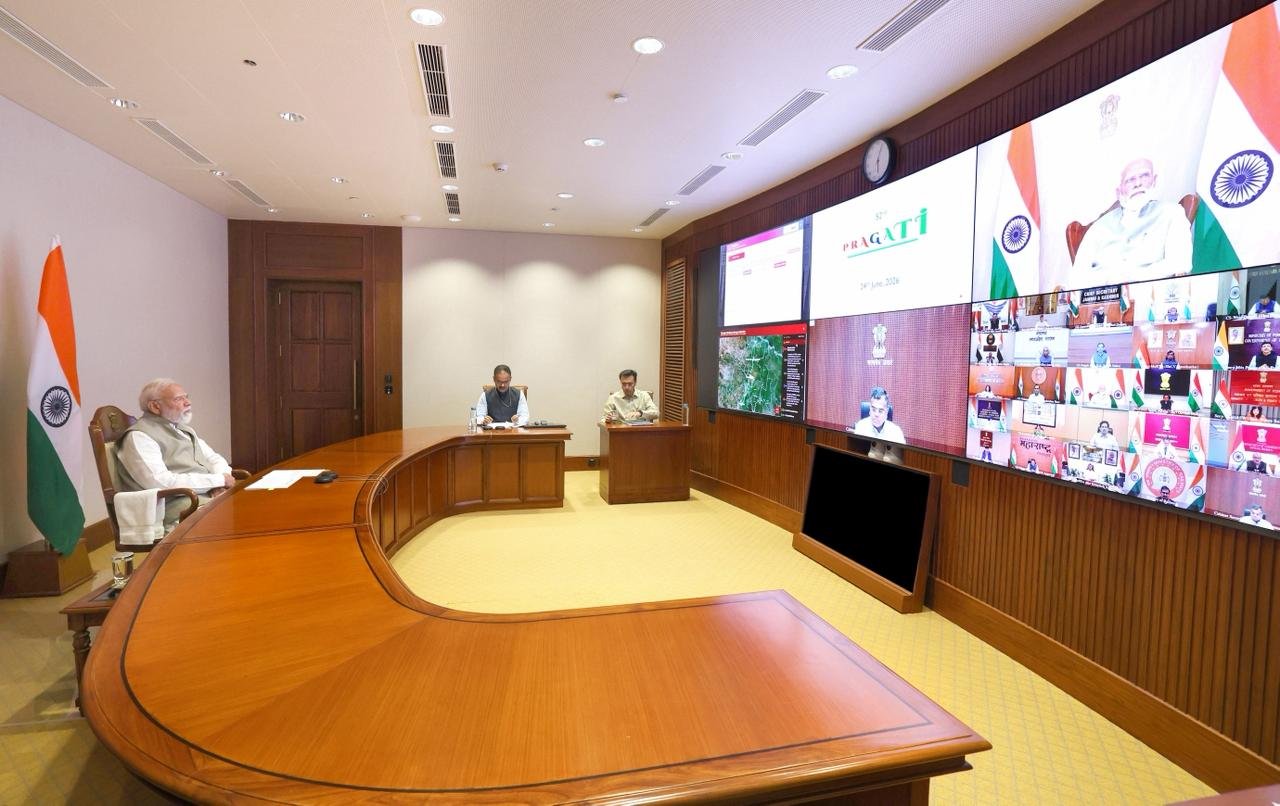
Prime Minister Narendra Modi recently chaired the 52nd PRAGATI Meeting, an ICT-enabled multi-modal platform designed to foster Pro-Active Governance and Timely Implementation. During the high-level meeting at Seva Teerth, the Prime Minister conducted a strategic review of four major infrastructure projects valued at approximately ₹30,000 crore. Spanning four states, these projects cover key sectors including Roadways, Power transmission, Industrial Corridors, and Metro Rail, reflecting the government’s focus on accelerating national growth through inter-agency coordination.
The PRAGATI platform, which brings together Central and State Governments, serves as a crucial tool for resolving administrative bottlenecks. By directly connecting the Prime Minister’s Office (PMO) with Union Secretaries and State Chief Secretaries, the platform helps ensure that major public interest projects do not suffer from unnecessary delays.
Major Decisions Taken at the 52nd PRAGATI Meeting
- Mega Infrastructure Review: Four key projects worth ₹30,000 crore across four states were evaluated for timeline adherence.
- PM GatiShakti Integration: PM Modi directed ministries to use GatiShakti data layers for real-time tracking and planning.
- Healthcare Digitization: Reviewed the TB Mukt Bharat Abhiyan with instructions to integrate Artificial Intelligence (AI) and engage youth volunteers.
- Cyber Security Initiatives: Addressed rising concerns over “Digital Arrests” and financial fraud, advocating for the implementation of e-Zero FIR systems.
- Inter-Agency Coordination: Directed Central Ministries and State Cabinets to resolve pending land and clearance issues in a “mission-mode” manner.
Accelerating Infrastructure: ₹30,000 Crore Projects Under Review
A primary focus of the 52nd PRAGATI Meeting was the detailed review of four large-scale infrastructure projects. These projects, representing the Road, Power, Industrial Corridor, and Metro Rail sectors, are critical for regional connectivity and economic development. The Prime Minister noted that project delays do not merely increase construction costs; they also delay the economic benefits intended for local communities and industries.
To address this, PM Modi instructed relevant ministries and state governments to resolve pending land acquisition, environmental clearances, and utility shifting issues promptly. He emphasized that monitoring at the highest administrative levels is necessary to maintain momentum on these projects and prevent administrative delays from stalling progress on the ground.
For official updates on central infrastructure planning, visit the Prime Minister of India Official Portal.
Enhancing Planning via the PM GatiShakti National Master Plan
During the proceedings of the 52nd PRAGATI Meeting, the Prime Minister emphasized the role of the PM GatiShakti National Master Plan in modernizing infrastructure planning. PM GatiShakti acts as a unified digital platform, integrating GIS-based data layers from various ministries to facilitate coordinated planning for multi-modal connectivity.
The Prime Minister underlined the need for regular and timely updates of project details, utility lines, and regulatory clearances on the GatiShakti portal. He stated that the platform must accurately reflect current ground realities to allow administrative bodies to anticipate potential bottlenecks and make data-driven decisions that prevent execution delays.
To learn more about how GIS data is used in national logistics, you can read about the PM GatiShakti Portal.
Revitalizing the TB Mukt Bharat Abhiyan Using AI
The 52nd PRAGATI Meeting also served as a review platform for public health, specifically the progress of the Pradhan Mantri TB Mukt Bharat Abhiyan. The Prime Minister emphasized the need to integrate modern digital technologies, such as Artificial Intelligence (AI), to improve tuberculosis screening, diagnostic accuracy, and patient treatment compliance.
To turn the health campaign into a broader public movement, PM Modi proposed engaging youth organizations. He suggested utilizing National Cadet Corps (NCC) cadets and “MY Bharat” volunteers to assist with community mobilization, patient follow-up, and raising awareness in rural areas. This community-based approach aims to ensure that healthcare support reaches vulnerable populations effectively.
Addressing Cyber Crime and the Threat of “Digital Arrests”
Addressing security challenges at the 52nd PRAGATI Meeting, the Prime Minister raised concerns regarding the rise in cyber crime and fraudulent schemes like “Digital Arrests.” He noted that digital platforms are increasingly being misused to defraud citizens, requiring a sensitive and coordinated response from law enforcement agencies, financial institutions, and digital platforms.
PM Modi stressed that victims of cyber fraud should not have to navigate multiple departments to seek redress. He called for clearer institutional ownership, faster response times, and improved public awareness campaigns to prevent financial losses. Additionally, he urged state governments to implement **e-Zero FIR** mechanisms, allowing citizens to file immediate complaints online regardless of jurisdictional boundaries, which helps law enforcement freeze fraudulent bank accounts quickly.
Relevance for UPSC and State PSC Aspirants
For aspirants preparing for competitive examinations, the 52nd PRAGATI Meeting provides essential insights into public administration, technology-enabled governance, and cyber security policies. Additional policy breakdowns are available in our National News and Policy Analysis section.
UPSC Civil Services Examination (CSE) Syllabus
- GS Paper II (Governance): Important aspects of governance, transparency, and accountability; e-governance applications, models, successes, and limitations (PRAGATI as a model for proactive governance).
- GS Paper III (Infrastructure and Security): Growth and development of infrastructure (Roads, Metro Rail, Power); cyber security, preventing cyber financial frauds, and the role of digital technologies in healthcare.
State PSC (CGPSC/State Exams) Syllabus
- Administrative Reforms: Use of ICT platforms in state administration, coordination between Union and State executives, and the implementation of central healthcare schemes like TB Mukt Bharat.
- Internal Security: Cyber crime prevention frameworks at the state level, the role of police departments in implementing e-Zero FIRs, and digital awareness initiatives.
Quick Revision Table: 52nd PRAGATI Meeting
| Key Parameter | Meeting Focus & Outcomes |
|---|---|
| Event Name | 52nd PRAGATI Meeting |
| Chaired By | Prime Minister Narendra Modi (at Seva Teerth) |
| Infrastructure Value | Four projects evaluated, worth approximately ₹30,000 crore |
| Key Sectors Covered | Roadways, Power Transmission, Industrial Corridors, Metro Rail |
| Health Scheme Reviewed | TB Mukt Bharat Abhiyan (advocating AI and youth volunteer mobilization) |
| Security Directives | Coordinated response to Cyber Crime, addressing “Digital Arrests”, and promoting e-Zero FIRs |
Frequently Asked Questions (FAQs)
1. What was the primary focus of the 52nd PRAGATI Meeting?
The primary focus of the 52nd PRAGATI Meeting was to review four critical infrastructure projects worth ₹30,000 crore, evaluate the progress of the TB Mukt Bharat Abhiyan, and establish administrative directives to counter cyber crime and digital fraud.
2. What is the PRAGATI platform in Indian governance?
PRAGATI (Pro-Active Governance and Timely Implementation) is an ICT-enabled, multi-purpose platform launched in 2015. It allows the Prime Minister to interact directly with Union Secretaries and State Chief Secretaries to monitor and fast-track key projects and address public grievances.
3. How did the Prime Minister suggest improving the TB Mukt Bharat Abhiyan?
During the meeting, the Prime Minister suggested utilizing Artificial Intelligence (AI) for diagnostics and patient tracking, alongside mobilizing NCC cadets and “MY Bharat” volunteers to raise awareness and support patient follow-up at the community level.
4. What administrative solutions were proposed for cyber crime and “Digital Arrests”?
PM Modi emphasized the need for close coordination between banks, digital platforms, and police departments. He also urged state governments to adopt e-Zero FIR systems to allow immediate reporting and faster action against cyber financial fraud.
5. Why is the PM GatiShakti National Master Plan important for PRAGATI projects?
The GatiShakti platform provides GIS-mapped data layers that help planners identify physical and regulatory bottlenecks before construction begins. Regular updates on this portal are essential for maintaining accurate, real-time data for project execution.
Conclusion
The monitoring process utilized in the 52nd PRAGATI Meeting illustrates the government’s approach to administrative oversight, combining infrastructure development with public safety and health management. By linking major project evaluations with directives on cyber security and public health digitization, the platform helps ensure that policy implementation remains responsive to changing public needs. Ultimately, proactive coordination between central and state authorities, as demonstrated by the outcomes of the 52nd PRAGATI Meeting, remains essential for achieving timely development across the nation.