The quiet hills of Chhattisgarh have made a significant statement on environmental conservation. By dispersing over two lakh seed balls in just twenty-four hours, the local forest department has done more than just plant trees—they have created a global benchmark. This collective ecological effort has officially entered the history books, with the Jashpur Forest Division World Record now certified by the prestigious Golden Book of World Records.
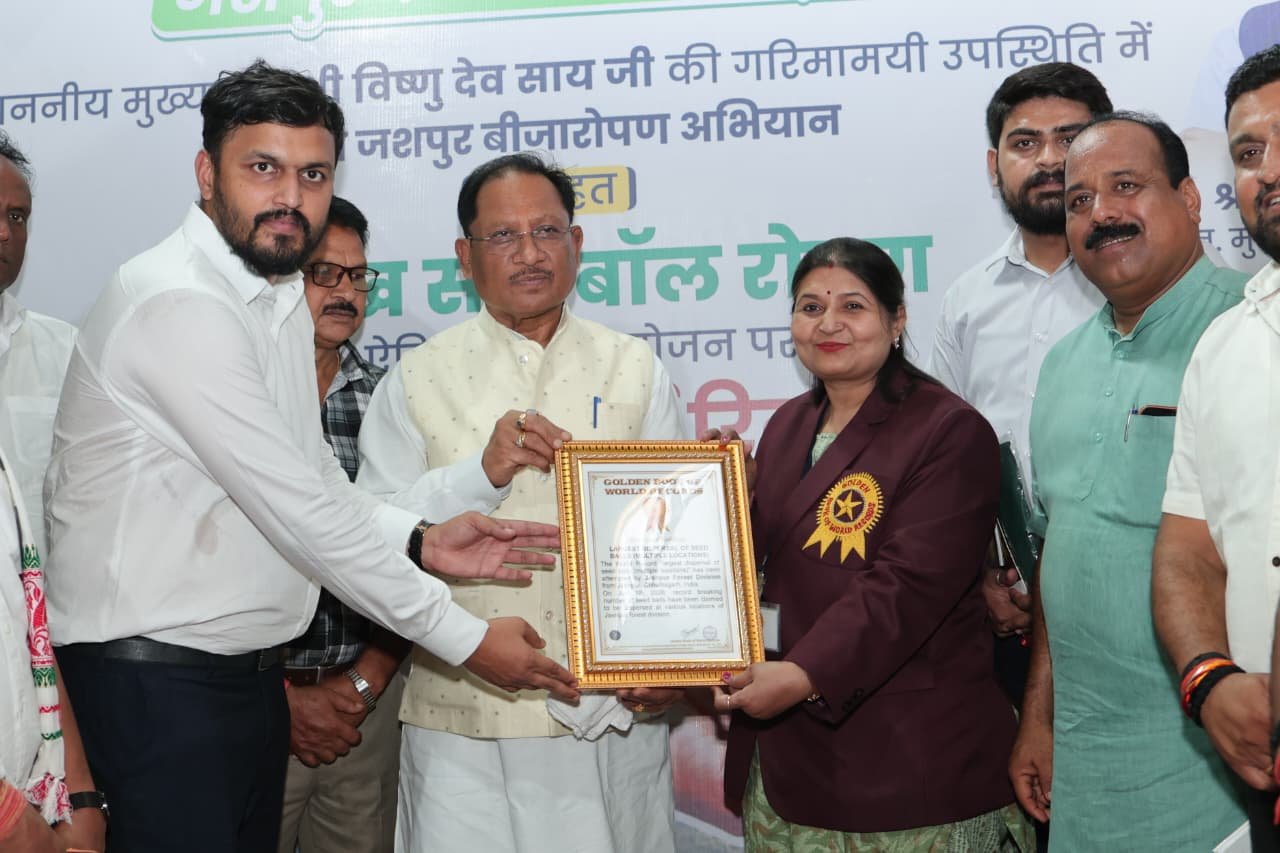
Chief Minister Vishnu Deo Sai witnessed the presentation of the official world record certificate at the CM Camp Office in Bagia. The State Head of the Golden Book of World Records, Sonal Rajesh Sharma, handed over the certificate to Jashpur Divisional Forest Officer (DFO) Shashi Kumar, marking a proud moment for the state’s environmental planners and administrative machinery.
Key Highlights of the Jashpur Forest Division World Record
- The Milestone: More than 2,00,000 native seed balls were prepared and dispersed in a single day across Jashpur.
- Global Recognition: Officially recorded and certified by the Golden Book of World Records.
- The Core Campaign: Executed under the regional slogan, “Beej Gola Banabo, Jashpur ke Jungle la Badhabo” (Let’s make seed balls and grow Jashpur’s forests).
- Broad Public Support: The drive saw active participation from local villagers, school students, forest officials, and women Self-Help Groups (SHGs).
- Key Dignitaries Present: The event was attended by District Panchayat President Salik Sai, Jashpur Collector Rohit Vyas, and SSP Dr. Lal Umed Singh.
How Jashpur Forest Division Secured the World Record
The record-breaking drive was not an overnight feat; it required meticulous planning and weeks of local mobilization. Under the direct supervision of the Jashpur Forest Division, field staff identified degraded forest patches, dry hill slopes, and areas vulnerable to soil erosion where traditional plantation drives are difficult to execute. This strategic execution is what allowed the team to secure the coveted Jashpur Forest Division World Record.
Speaking on the occasion, Chief Minister Vishnu Deo Sai emphasized that protecting the environment is not a task that the government can accomplish alone. He noted that the campaign successfully turned a regular administrative target into a genuine public movement. The Chief Minister pointed out that when local communities take ownership of their natural resources, the results are both highly effective and sustainable.
By coordinating the efforts of the forest department with local panchayats and community leaders, the administration ensured that the seed balls were distributed evenly across targeted zones. This organized approach allowed the division to cross the two-lakh mark within the stipulated twenty-four-hour window, sealing the Jashpur Forest Division World Record on a global scale.
The “Beej Gola” Campaign: A Model for Public Participation
The heart of this record lies in the local phrase, “Beej Gola Banabo, Jashpur ke Jungle la Badhabo.” By using the local dialect, the forest department established an immediate connection with the tribal and rural populations of Jashpur. This linguistic and cultural connection helped transform a government scheme into a community festival, paving the way for the milestone now recognized as the Jashpur Forest Division World Record.
Women Self-Help Groups (SHGs) under the National Rural Livelihoods Mission (NRLM) played a central role in preparing the seed balls. They collected fertile soil, organic manure, and seeds of native forest trees. This collaborative model not only supported the environmental campaign but also provided seasonal income opportunities for rural households. For more state-level initiatives, you can explore our dedicated section on Chhattisgarh Current Affairs.
The Science Behind Seed Balls
To understand the foundation of the Jashpur Forest Division World Record, one must look at the science of seed-bombing. Seed balls, also known as “seed bombs,” are an ancient reforestation technique modernized by agricultural pioneer Masanobu Fukuoka. The process is straightforward yet highly scientific:
- The Protective Layer: A mixture of clay and organic compost wraps around a central seed. This shell protects the seed from being eaten by birds, rodents, or insects.
- Nutrient Reserve: The compost within the ball provides essential nutrients the moment water triggers germination.
- Natural Timing: The seed balls remain dormant on the ground until the monsoon rains arrive. Once wet, the clay softens, allowing the root to penetrate the soil quickly.
- Inaccessible Terrains: They can be thrown into deep valleys, steep hillsides, and rocky terrains where human tree-planters cannot safely go.
Understanding the Jashpur Forest Division World Record and Its Impact
Jashpur’s geography is unique, characterized by flat-topped hills known as pats, dense valleys, and rapid water runoff during the monsoon. Traditional sapling planting on steep slopes is often expensive and yields low survival rates due to soil erosion. The execution of the Jashpur Forest Division World Record provides a clear demonstration of how low-cost, decentralized techniques can overcome these geographical challenges.
By deploying seed balls, the forest department has selected a highly cost-effective method. The cost of preparing and dispersing a seed ball is a fraction of the cost associated with raising a sapling in a nursery, transporting it, digging pits, and maintaining it. If even half of the two lakh seed balls germinate successfully, Jashpur will gain a substantial number of new trees at minimal cost, solidifying the long-term impact of this project.
Ecological and Economic Benefits
The primary tree species selected for the seed balls include native trees such as Harra, Baheda, Mahua, Karanj, and Neem. These species are well-suited to the local climate and serve multiple ecological functions. The success of the Jashpur Forest Division World Record depends on these native species:
First, their deep root systems help bind the soil, preventing the erosion of topsoil during heavy rains. Second, these native trees support local wildlife, which helps minimize human-animal conflicts in the region. Finally, trees like Mahua and Karanj provide non-timber forest produce (NTFP), offering long-term economic support to the local tribal communities, as outlined in official guidelines on the Government of Chhattisgarh Portal.
Relevance for UPSC and CGPSC Aspirants
For students preparing for competitive exams like the UPSC Civil Services and the Chhattisgarh Public Service Commission (CGPSC), this development provides an excellent case study on modern forestry and administrative practices. Understanding the administrative strategies behind the Jashpur Forest Division World Record is highly beneficial for essay and environment papers. You can find similar study guides in our UPSC Exam Resources section.
UPSC Syllabus Connection
- GS Paper III (Environment and Biodiversity): Community-led conservation, afforestation strategies, and low-cost ecological restoration techniques aligned with the Press Information Bureau (PIB) updates on National Action Plan on Climate Change (NAPCC).
- GS Paper IV (Ethics and Case Studies): Public participation in governance and the role of administration in mobilizing citizen-led ecological initiatives.
CGPSC Syllabus Connection
- Geography of Chhattisgarh: Physical features of the Jashpur-Samri Pat region, forest types, and soil conservation programs in the state.
- State Initiatives: Decentralized forestry models and the integration of rural livelihoods with environmental conservation.
Quick Revision Table for Competitive Exams
| Parameter | Details for Revision |
|---|---|
| Achieving Entity | Jashpur Forest Division, Chhattisgarh |
| Record Type | Jashpur Forest Division World Record (Golden Book of World Records) |
| Campaign Slogan | “Beej Gola Banabo, Jashpur ke Jungle la Badhabo” |
| Chief Guest | Chief Minister Vishnu Deo Sai |
| Key Species Used | Harra, Baheda, Mahua, Karanj, Neem (Native Species) |
Frequently Asked Questions (FAQs)
1. What is the Jashpur Forest Division World Record?
The Jashpur Forest Division set a world record by dispersing more than two lakh seed balls across designated forest areas within a single day. This environmental achievement is officially certified as the Jashpur Forest Division World Record by the Golden Book of World Records.
2. How does the Jashpur Forest Division World Record benefit local communities?
The campaign actively involved local tribal villagers and women Self-Help Groups (SHGs) in the preparation and dispersal of seed balls. This provided direct seasonal livelihood opportunities while restoring local forest reserves that provide non-timber forest produce.
3. Why are seed balls preferred over normal sapling planting in hilly regions?
Seed balls are highly cost-effective, easy to transport, and can be thrown into steep, rocky, or inaccessible areas where manual digging and planting are not possible. They also protect the seeds from pests and dry conditions until the monsoon begins.
4. Who prepared these seed balls?
The seed balls were prepared through a collaborative effort involving local villagers, school students, forest department staff, and women Self-Help Groups (SHGs) across the Jashpur district.
5. Which tree species were selected for this initiative?
The initiative focused on native tree species, including Harra, Baheda, Mahua, Karanj, and Neem, which are naturally adapted to Chhattisgarh’s climate and soil.
Conclusion
In conclusion, the Jashpur Forest Division World Record represents a landmark achievement in community-driven forest conservation. By replacing capital-intensive plantation methods with community-prepared seed balls, Jashpur has demonstrated a practical approach to landscape restoration. As states across India look for scalable ways to meet their green cover targets, the Jashpur Forest Division World Record offers an invaluable model for the future of decentralized, low-cost community forestry.