Published on TheExamHub.in | Economy & Finance | Updated: April 2026
RBI Releases Monetary Policy Report April 2026: India’s Economy Stays Strong Despite Global Storms
The Reserve Bank of India (RBI) has released its Monetary Policy Report (MPR) for April 2026. This report gives a detailed picture of how India’s economy is doing — covering inflation, growth, financial markets, and the global economic environment.
Whether you are a student, a bank exam aspirant, or just someone who wants to understand how the economy affects your daily life — this article breaks it all down in simple language.
🔑 Key Highlights at a Glance
| Topic | Key Finding |
|---|---|
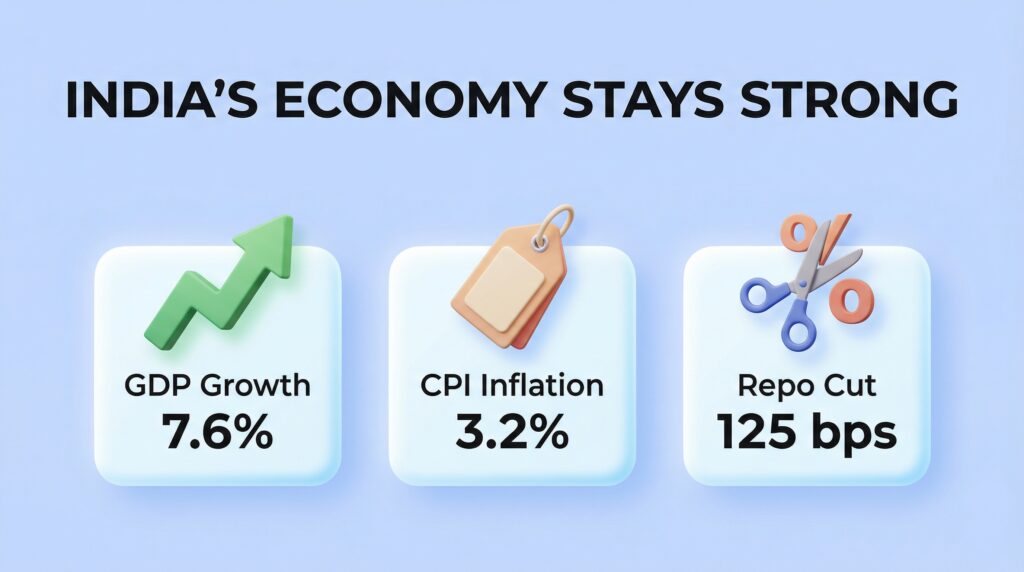
| GDP Growth (2025-26) | 7.6% — up from 7.1% last year |
| CPI Inflation (Feb 2026) | 3.2% — below the 4% target |
| Repo Rate Cuts (Since Feb 2025) | 125 basis points (bps) cumulative |
| Bank Credit Growth | 13.8% (as of March 15, 2026) |
| India’s Forex Reserves | US$ 688.1 billion |
| India’s Current Account Deficit | 1.0% of GDP (April-December 2025) |
🌍 Part 1: What is Happening in the World Economy?
Global Growth is Slow but Stable
The world economy is growing, but below its long-term average. The International Monetary Fund (IMF) projected global growth at 3.3% for 2026, while the OECD kept its 2026 forecast at 2.9%.
Why is global growth slow?
- Trade tensions and tariff wars (especially US tariffs)
- Geopolitical conflicts — particularly the West Asia conflict that broke out around end-February 2026
- Rising energy prices due to the conflict
- Uncertainty around technology stocks
The AI Factor
One bright spot is Artificial Intelligence (AI)-related investment, which has been boosting growth in many countries, especially the US. AI-related technology stocks supported global equity markets for most of 2025.
The West Asia Conflict — A Major Risk
The biggest new development since the last MPR (October 2025) is the outbreak of conflict in West Asia in late February 2026. This has:
- Pushed crude oil prices sharply higher
- Caused global equity markets to fall
- Led to currency depreciation in many emerging markets
- Created supply disruption risks for energy, fertilisers, and key commodities
💰 Part 2: Global Commodity Prices and Inflation
Crude Oil Prices Spiked
Brent crude oil, which had been falling for much of 2025, rebounded sharply in March 2026 due to West Asia tensions. This is a key risk to India’s inflation going forward.
Gold Hit Record Highs
Gold prices doubled from around US$2,060 per ounce at end-2023 to US$5,000 per ounce by February 2026 — a historic surge. The RBI report even explored whether gold prices showed “bubble-like” behaviour in 2025, using a statistical method called the Right-tailed Augmented Dickey-Fuller (RADF) test. The findings suggest gold entered a phase of explosive price escalation in 2025.
Global Inflation: Mixed Picture
- US inflation (PCE measure): Still slightly above the 2% target
- UK inflation: Trending lower but still above target
- Euro area inflation: Rose to 2.5% in March 2026
- India’s inflation: Comfortably below target at 3.2% in February 2026
🏦 Part 3: What Did the RBI Do? — Monetary Policy Actions
Repo Rate Cuts: 125 bps Since February 2025
The Monetary Policy Committee (MPC) cut the policy repo rate by 25 bps in December 2025. This brings the total rate cut to 125 bps (1.25%) since February 2025 — meaning borrowing has become significantly cheaper over the past year.
What does this mean for you?
- Home loans, car loans, and personal loans are becoming cheaper
- Fixed deposit rates are also coming down gradually
- Banks are passing on the benefit to borrowers
Neutral Stance Maintained
The MPC decided to maintain its “neutral” monetary policy stance — meaning it is neither aggressively cutting rates nor hiking them. It is watching how the economy and global conditions evolve before making the next move.
Cash Reserve Ratio (CRR) Cut
RBI also cut the CRR (the amount banks must keep with RBI) by 100 bps to 3% in a phased manner. This injected more money into the banking system, helping banks lend more freely.
💧 Part 4: Money in the Banking System (Liquidity Conditions)
Surplus Liquidity Throughout H2
The banking system had surplus liquidity (more money than needed) throughout the second half of 2025-26 (October 2025 to March 2026), except on a few occasions when tax payments temporarily tightened conditions.
RBI Took Several Steps to Inject Money
To ensure enough money flows in the economy, RBI undertook:
- Open Market Operations (OMO): Bought government bonds worth ₹5 lakh crore in H2
- USD/INR Buy-Sell Swap Auctions: Approximately ₹2.27 lakh crore injected
- Term Repo Auctions: ₹1.37 lakh crore injected
- CRR Cuts: Approximately ₹1.88 lakh crore released into the system
Total liquidity injected in H2 alone: approximately ₹10.5 lakh crore
📊 Part 5: Financial Markets — How Did They Perform?
Stock Market: Gains Then Sharp Fall
Indian equity markets gained in October and November 2025 on strong corporate results and Fed rate cuts. However, markets fell sharply from end-February 2026 as West Asia tensions intensified. The BSE Sensex P/E ratio fell to 19.8 at end-March 2026 from 22.2 at end-September 2025.
Sector Performance (H2:2025-26)
- 📈 Metal stocks were the only sector to gain (+10.7%) — driven by rising global precious metal prices
- 📉 Realty, IT, FMCG, Auto — all fell between 3-25%
Indian Rupee (INR) — Depreciation Pressure
The rupee depreciated by 6.2% against the US dollar in H2:2025-26. However, the RBI notes that despite this, the INR was among the least volatile emerging market currencies in this period, supported by India’s modest current account deficit and strong forex reserves.
Key rupee moments:
- Appreciated in early February 2026 after India-US interim trade deal announcement
- Fell in March 2026 as West Asia conflict intensified
Government Bond Yields Rose
Long-term government bond yields (G-Sec) generally hardened (went up) in H2 due to:
- Rising crude oil prices
- Higher US bond yields
- FPI outflows from India
- Higher government borrowings announced in Budget 2026-27
🏦 Part 6: Bank Credit Growth — Good News!
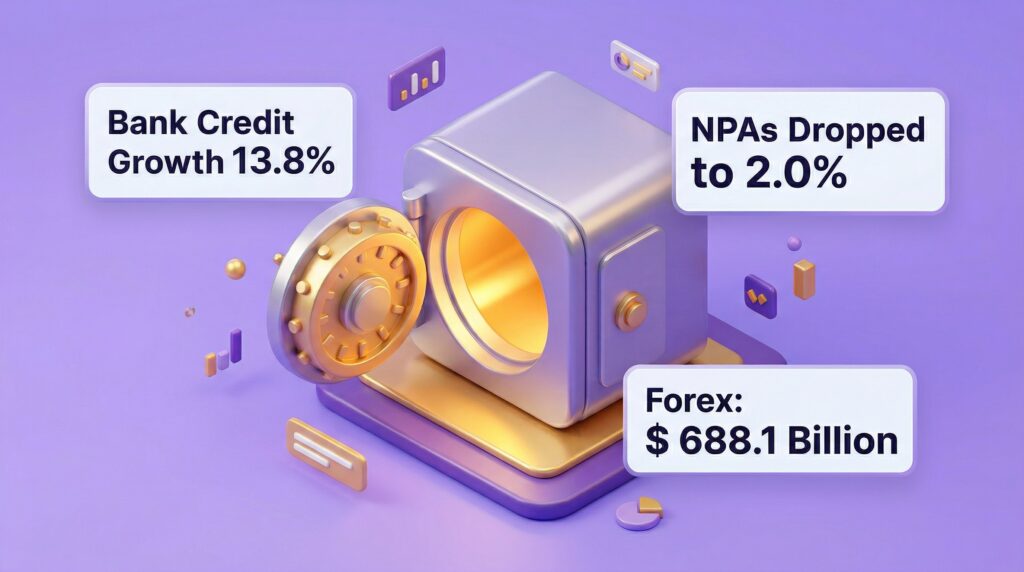
Bank credit (loans given by banks) grew at a strong 13.8% as of March 15, 2026 — up from 11% a year ago. This is a very positive sign for the economy.
Which Sectors Got the Most Loans?
- MSMEs (Micro, Small, Medium Enterprises): 27.5% growth — outstanding!
- Infrastructure: 7.9% growth
- Housing Loans: 11% growth
- Vehicle Loans: 17.1% growth
- Gold Jewellery Loans: Surged by 71.9% (from NBFCs)
Banks’ Health Improved
Bad loans (Non-Performing Assets or NPAs) fell to just 2.0% of total loans in December 2025 — down from 2.5% a year ago. This is the best level in many years, showing that Indian banks are in very good health.
🌾 Part 7: India’s Economy — Demand and Supply
GDP Growth at 7.6% in 2025-26
India’s economy grew at an impressive 7.6% in 2025-26 (as per Second Advance Estimates with the new base year 2022-23), higher than 7.1% in 2024-25.
Quarterly GDP growth in 2025-26:
- Q1 (Apr-Jun 2025): 6.7%
- Q2 (Jul-Sep 2025): 8.4% (strong!)
- Q3 (Oct-Dec 2025): 7.8%
- Q4 (Jan-Mar 2026, implicit): 7.3%
What Drove This Growth?
On the demand side:
- Private Consumption (people spending money): Grew 7.7% — the biggest driver
- Investment (GFCF): Grew 7.1% — second biggest driver
- Government Spending: Grew 6.6%
On the supply side:
- Services sector: Grew 8.7% — the backbone of India’s economy
- Industry (Manufacturing): Grew 9.5%
- Agriculture: Slowed to 2.4% due to weather disruptions
Agriculture — Record Food Production
Despite some weather disruptions, foodgrains production hit a record 3,487 lakh tonnes in 2025-26 — 3% more than last year. Wheat production reached a record 1,202 lakh tonnes.
💸 Part 8: India’s Fiscal Position (Government Finances)
Central Government Fiscal Deficit at 4.4% of GDP
The Central Government kept its Gross Fiscal Deficit (GFD) at 4.4% of GDP in 2025-26 (Revised Estimates) — within its target. For 2026-27, the government has budgeted an even lower deficit of 4.3% of GDP.
Good sign: The government maintained capital expenditure at 3.1% of GDP while controlling revenue spending — meaning it is spending on productive infrastructure rather than just day-to-day expenses.
Monthly GST Collections Stay Strong
Monthly GST collections (Centre + States combined) averaged ₹1.94 lakh crore in 2025-26 — reflecting healthy economic activity.
📈 Part 9: Inflation — Under Control, But Watch Out!
Inflation Dipped to Historic Low in October 2025
CPI inflation fell to just 0.3% in October 2025 — the lowest ever in the old CPI series (2012=100). This was mainly due to a sharp fall in food prices, especially vegetables.
But Inflation Has Since Picked Up
In the new CPI series (2024=100), inflation was:
- January 2026: 2.7%
- February 2026: 3.2%
This is still well below the 4% target, but the upward movement is being watched carefully.
New CPI Series (2024=100) — A Major Change
The government released a completely new CPI series with base year 2024 in February 2026. Key changes:
- Food weight reduced from 45.9% to 36.8% (reflects modern consumption patterns)
- More items covered: 358 items vs 299 earlier
- Rural house rent now included
- Free PDS (ration shop) items no longer counted
- New items like OTT subscriptions, CNG, health supplements added
Core Inflation Remains Contained
Core inflation (excluding food and fuel) was at 3.7% in February 2026 — broadly stable. The main pressure point is precious metals (gold and silver), whose prices surged globally.
The Big Risk: Energy Prices
The conflict in West Asia has:
- Caused crude oil prices to spike
- Led to LPG price hike of ₹60/cylinder in early March 2026
- Created potential fertiliser supply disruption risks
- Put upward pressure on future inflation
The Government responded by cutting Special Excise Duty on petrol and diesel by ₹10/litre to partially offset the fuel price shock.
🌐 Part 10: India’s Trade and External Position
Exports Holding On, Imports Rising
- Merchandise exports: Grew marginally by 0.8% in H2 (Oct-Feb)
- Merchandise imports: Grew at a higher pace → trade deficit widened
- Services exports: Grew a healthy 8.4% in H2
India remained one of the top 5 service-exporting countries in the world.
Gold Imports Surged
Gold imports jumped 78.5% to US$52 billion (Oct-Feb) driven entirely by price increases — a key pressure point for the trade balance.
FDI Inflows Surged
Foreign Direct Investment (FDI) inflows rose 18.1% to US$88.3 billion in 2025-26 (April-February). Top sectors: manufacturing, computer services, financial services.
Forex Reserves: Strong Buffer
India’s foreign exchange reserves stood at US$688.1 billion as of March 27, 2026 — enough to cover 10.9 months of imports. This is a strong buffer against external shocks.
📋 Part 11: The Road Ahead — What to Expect?
Inflation Outlook
The RBI projects:
- Inflation will remain broadly aligned with the target in the near term
- Upside risks have increased due to rising global energy prices (West Asia conflict)
- Downside surprises are possible if food prices remain benign
Growth Outlook
India’s growth outlook remains resilient:
- Trade deals with the EU and interim US deal framework provide upside
- Structural reforms and infrastructure spending supporting investment
- But West Asia conflict, volatile commodity prices, and supply chain disruptions pose risks
What Will RBI Do Next?
The RBI will continue to:
- Balance price stability with growth support
- Remain agile in liquidity management
- Monitor global developments — especially energy prices and West Asia situation — closely before deciding on further rate cuts
📝 Key Takeaways for Exam Aspirants
Here are the important facts from this MPR for bank exams, UPSC, and competitive examinations:
- Repo Rate cumulative cut since Feb 2025: 125 bps
- CRR reduced to: 3% of NDTL
- India GDP growth 2025-26: 7.6%
- CPI Inflation Feb 2026: 3.2% (new series)
- Bank credit growth: 13.8%
- Gross NPA ratio: 2.0% (December 2025)
- Forex reserves: US$688.1 billion
- New CPI base year: 2024 (old was 2012)
- New GDP base year: 2022-23 (old was 2011-12)
- Foodgrain production 2025-26: Record 3,487 lakh tonnes
- India’s FDI inflows: US$88.3 billion (April-February 2025-26)
- India’s CAD: 1.0% of GDP (April-December 2025)
✅ Conclusion
The RBI’s April 2026 Monetary Policy Report paints a picture of a strong and resilient Indian economy — growing at 7.6%, with inflation under control, healthy bank credit growth, and strong forex reserves. The RBI has been proactively cutting interest rates to support growth.
However, the West Asia conflict is the key risk that could push energy prices higher, increase inflation, and slow growth if it escalates further. The RBI is watching this situation very carefully and is committed to keeping prices stable while supporting growth.
For India, the fundamentals remain strong. The challenge is to navigate global uncertainty wisely — and the RBI, with its careful approach, appears well-equipped to do exactly that.
Source: Reserve Bank of India Monetary Policy Report, April 2026 | Published under Section 45ZM of the RBI Act, 1934 https://rbidocs.rbi.org.in/rdocs/Publications/PDFs/MPRAPRIL080426F22A3C8019DF4BDE889912B6209E8B7B.PDF
Article compiled and simplified for theexamhub.in readers | For educational and informational purposes