India once again proves its growing stature in the global space community as Bangalore becomes the epicenter of cutting-edge space mission discussions
India Takes Centre Stage in Global Space Dialogue
Bangalore, the silicon valley of India and home to the country’s most ambitious space dreams, welcomed the world’s brightest space minds from April 8 to 10, 2026. The second edition of the International Conference on Spacecraft Mission Operations — SMOPS-2026 brought together global space agencies, industry leaders, academics, startups, and young professionals under one roof for three days of intense knowledge sharing, collaboration, and forward-looking discussions.
The theme of the conference — “Innovative Operations for Smart and Sustainable Space Mission Management – Next Generation” — perfectly captured the spirit of where space exploration is heading in this decade and beyond.
This was not just another conference. This was a watershed moment for India’s space sector.
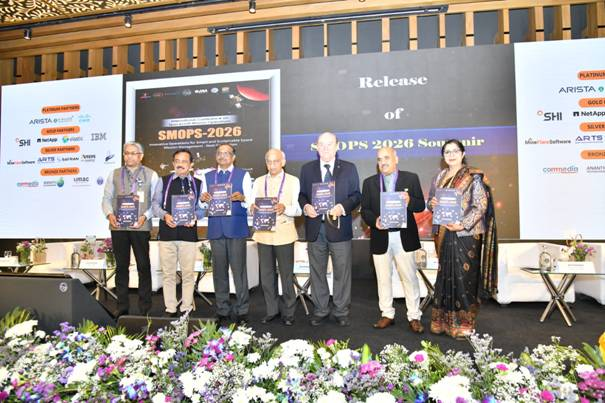
What Is SMOPS-2026 and Why Does It Matter?
SMOPS stands for Spacecraft Mission Operations, and the 2026 edition is only the second of its kind ever held in India. The conference was jointly organized by three prestigious institutions:
- Indian Space Research Organisation (ISRO)
- Astronautical Society of India (ASI)
- International Academy of Astronautics (IAA)
Together, they created an unparalleled platform where the best minds from across the globe could discuss the present challenges, future possibilities, and the next-generation solutions needed in spacecraft mission operations.
What makes SMOPS-2026 particularly significant is its timing. India is currently riding an extraordinary wave of space achievements — from the historic soft landing of Chandrayaan-3 on the Moon’s south pole to the successful docking experiments in the SpaDEx mission. With the Gaganyaan human spaceflight mission on the horizon and India’s space sector opening up to private players, the need for collaborative, innovative, and sustainable mission operations has never been more urgent.
SMOPS-2026 arrived at exactly the right moment.
The Inauguration: Visionaries Lead the Way
The conference was officially inaugurated on April 8, 2026, by Shri A S Kiran Kumar, the erstwhile Chairman of ISRO and Secretary of the Department of Space (DOS). His presence at the inauguration itself was deeply symbolic — here was a man who had steered India through some of its most glorious space missions, now passing the baton forward to the next generation of space thinkers.
The inauguration was attended by a galaxy of distinguished dignitaries:
- Dr. V. Narayanan — Current Chairman, ISRO / Secretary, DOS
- Shri M Sankaran — Director, U R Rao Satellite Centre (URSC)
- Dr. Jean Michel Contant — Secretary General, International Academy of Astronautics (IAA)
- Dr. A K Anil Kumar — Director, ISRO Telemetry, Tracking and Command Network (ISTRAC)
During his inaugural address, Chairman ISRO Dr. V. Narayanan delivered a powerful message that resonated with every participant in the room. He emphasized the critical role of meticulous planning and flawless execution of spacecraft mission operations in determining the success of space missions. No matter how brilliant the science is, he noted, it is the operations that make or break a mission.
He further stressed the need for the Indian space sector to proactively engage with global counterparts in finding innovative, collaborative solutions to the rapidly evolving and increasingly complex challenges of modern space operations. In a world where space is becoming more crowded, more competitive, and more commercially driven, international cooperation is not optional — it is essential.
Key Themes That Defined SMOPS-2026
The conference was structured around twelve powerful and forward-thinking themes, each addressing a critical aspect of modern spacecraft operations:
1. Mission Operations: Turning Design into Achievement
This theme bridged the often-wide gap between how a mission is designed on paper and how it actually performs in the harsh reality of space. Speakers discussed real-world case studies and operational lessons that are rarely documented publicly.
2. Navigating Current Milestones & Future Horizons
A sweeping overview of where the global space community stands today — and where it needs to go. This session set the tone for much of the conference’s strategic discussions.
3. Mission Design and Operations
Deep dives into the technical architecture of mission design and how operational requirements must be baked in from Day One, not added as an afterthought.
4. Mission Operations Strategy and Future Roadmap
Long-term strategic thinking on how mission operations will evolve over the next decade, with changing technologies, increasing mission complexity, and new actors entering the space arena.
5. AI and Robotics
Perhaps the most buzzed-about theme of the conference. The role of Artificial Intelligence (AI) and Machine Learning (ML) in enabling smarter, faster, and more autonomous mission operations was a central discussion thread throughout SMOPS-2026.
6. Ground Segment and Constellations
With hundreds — and soon thousands — of satellites being launched into orbit, managing large constellations from the ground is one of the most pressing operational challenges of our time. This theme tackled it head-on.
7. Human Space Program, Interplanetary Missions and Ground Segment
With India’s Gaganyaan mission looming large and global ambitions pointing toward the Moon and Mars, this theme explored the unique challenges of supporting human spaceflight from the ground.
8. Orbits of Opportunity: Contributing to the New Space Economy
The commercial space revolution is real. This theme examined how mission operators can position themselves — and their nations — to benefit from the exploding New Space Economy.
9. Human Space Program Challenges
A candid look at the enormous technical, medical, psychological, and operational challenges of sending human beings into space — and bringing them back safely.
10. Robotic Mission Operations on ISS
The International Space Station continues to be humanity’s most complex operational challenge in space. This theme focused on the growing role of robotics in managing ISS operations.
11. Space Domain Awareness: Concepts, Capabilities and Applications
As space becomes more congested, space domain awareness — knowing exactly what is up there and where it is going — becomes a matter of safety and national security. This theme explored cutting-edge concepts and capabilities in this fast-evolving field.
12. Leveraging Space Applications
Space is not just about exploration — it is about changing lives on Earth. This theme celebrated and analyzed the real-world applications of space technology in sectors ranging from agriculture to disaster management.
A Truly International Gathering
One of the most striking aspects of SMOPS-2026 was the sheer diversity and calibre of international participation. The conference featured:
- 120 oral presentations
- 88 poster presentations
Keynote speakers and panelists flew in from some of the world’s most respected space organizations, including:
| Organization | Country/Region |
|---|---|
| ESA (European Space Agency) | Europe |
| CNES (French Space Agency) | France |
| DLR (German Aerospace Center) | Germany |
| IBMP and IKI | Russia |
| NASA | United States |
| JAXA | Japan |
| Celestrak | United States |
| Eumetsat | Europe |
| Eutelsat | Europe |
| TU Delft | Netherlands |
| Space Agency | Canada |
This constellation of global experts transformed SMOPS-2026 into a truly world-class event — one that demonstrated India’s ability to convene and lead global conversations in space technology.
The Central Challenge: Complexity, Congestion, and Collaboration
If there was one thread that ran through every session, every presentation, and every panel discussion at SMOPS-2026, it was this: Space is getting harder.
The combination of several simultaneous disruptive forces is creating unprecedented complexity in spacecraft mission operations:
🚀 Disruptive Technological Innovation — New technologies are emerging faster than operational frameworks can adapt. AI, quantum computing, advanced propulsion, and in-space manufacturing are all changing the game simultaneously.
📡 The Rise of Large Constellations — Companies like SpaceX’s Starlink and Amazon’s Kuiper are launching thousands of satellites into low Earth orbit, creating operational and collision-avoidance challenges that were unimaginable a decade ago.
🛸 Space Traffic Congestion — Low Earth orbit is getting crowded. The risk of collisions, the challenge of deorbiting spent satellites, and the growing threat of space debris require urgent international cooperation and new operational protocols.
🌕 More Ambitious Human Exploration — Beyond the International Space Station, humanity is planning to return to the Moon and eventually reach Mars. These missions demand entirely new levels of operational excellence, autonomy, and resilience.
The pivotal role of Artificial Intelligence and Machine Learning was underscored repeatedly across sessions as the key enabler of more autonomous, efficient, and intelligent mission operations. The concept of human-machine synergy — where AI augments human decision-making rather than replacing it — emerged as the dominant operational philosophy for next-generation missions.
STRAC: The Quiet Hero Behind India’s Space Successes
No story about SMOPS-2026 is complete without acknowledging the organization that played a leading role in organizing this landmark event — ISTRAC (ISRO Telemetry, Tracking and Command Network).
ISTRAC is the backbone of Indian spacecraft operations. It is the nerve centre through which ISRO communicates with, tracks, and controls every satellite and spacecraft it has ever launched. Its landmark achievements read like a hall of fame of Indian space history:
- Aryabhata — India’s very first satellite, launched in 1975
- Mangalyaan (Mars Orbiter Mission) — India’s historic and audacious first interplanetary mission, which made India only the fourth nation and the first Asian country to reach Mars orbit
- Chandrayaan-3 — The soft landing on the Moon’s south pole that made the whole world watch in breathless admiration
- Aditya-L1 — India’s first solar observatory, successfully inserted into the Lagrangian Point around the Sun
- SpaDEx Mission — The successful docking experiments that placed India among the elite club of nations with space docking capability
- NISAR — The ambitious joint Earth observation mission with NASA, whose operations ISTRAC will manage
From India’s very first satellite to its most sophisticated missions, ISTRAC has been there — quietly, competently, and brilliantly. It was entirely fitting that ISTRAC took the lead in organizing a conference dedicated to the art and science of spacecraft operations.
Special Workshop for Students and Young Professionals
One of the most heartwarming and forward-looking aspects of SMOPS-2026 was the exclusive workshop for students and young professionals held on April 10 — the final day of the conference.
The workshop featured invited talks covering some of the most exciting frontiers in space operations:
- Robotic Mission Operations on the ISS
- Space Domain Awareness
- Space Applications and Their Real-World Impact
- Human Space Missions
- Astronaut Training
The response was overwhelming. Young students and early-career professionals from across India — and beyond — packed the venue, hungry to learn, to connect, and to be inspired.
This is exactly what India needs. As ISRO embarks on its most ambitious missions yet, as India’s private space sector grows rapidly, and as the country positions itself as a global space power, the next generation of mission operators, engineers, scientists, and policymakers must be ready. SMOPS-2026 made a powerful investment in that future.
A Confluence of Ideas for a Sustainable Space Future
In the backdrop of the rapid opening up of India’s space sector — with new startups, private launch vehicles, commercial satellite operators, and a policy framework that actively encourages private participation — SMOPS-2026 served as a rich confluence of ideas across multiple disciplines.
The conference brought together:
- Space agencies — sharing operational experiences and future plans
- Startups — showcasing disruptive innovations and new approaches
- Industry leaders — discussing scalable solutions and commercial viability
- Academia — contributing research insights and theoretical frameworks
Together, they worked toward a shared goal: charting a safe, sustainable, and smart roadmap for future space mission operations.
This is the essence of what makes SMOPS special. It is not just a technical conference. It is a movement — a collective commitment by the global space community to ensure that as we reach higher and farther into space, we do so responsibly, collaboratively, and with wisdom.
Why SMOPS-2026 Matters for India — and the World
India is at a historic inflection point in its space journey. The country has demonstrated that it can reach the Moon, orbit the Sun, dock spacecraft autonomously, and inspire a billion people to look up at the stars. Now, with human spaceflight on the agenda and a booming private space sector, India is transitioning from being a participant in the global space story to being one of its principal authors.
SMOPS-2026 is a powerful symbol of this transformation. By bringing the world’s best space minds to Bangalore, by hosting 208 presentations across 12 cutting-edge themes, by engaging students and young professionals, and by facilitating meaningful international partnerships — India has demonstrated that it is not just capable of great missions in space.
India is capable of leading the global conversation about how we operate in space.
Quick Facts: SMOPS-2026 at a Glance
| Detail | Information |
|---|---|
| Conference Name | SMOPS-2026: International Conference on Spacecraft Mission Operations |
| Edition | Second |
| Dates | April 8-10, 2026 |
| Venue | Bangalore, India |
| Theme | Innovative Operations for Smart and Sustainable Space Mission Management – Next Generation |
| Organizers | ISRO, ASI, IAA |
| Oral Presentations | 120 |
| Poster Presentations | 88 |
| International Participants | ESA, CNES, DLR, NASA, JAXA, Celestrak, Eumetsat, Eutelsat, TU Delft, Canada, Russia |
| Special Workshop | Students and Young Professionals — April 10 |
Conclusion: The Future of Space Operations Starts Here
SMOPS-2026 has concluded, but its impact will be felt for years to come. The partnerships forged in Bangalore’s conference halls, the ideas shared across 208 presentations, the young minds inspired by astronaut training talks and robotics demonstrations — all of this will shape how India and the world approach space mission operations in the decade ahead.
As Dr. V. Narayanan, Chairman of ISRO, reminded the gathering: meticulous planning and flawless execution are the cornerstones of every successful space mission. SMOPS-2026 embodied both.
The stars are calling. And India is more than ready to answer.
This article is based on an official PIB press release dated April 8, 2026. All facts, figures, and quotes have been sourced from the official government release.
Good Article