Science and public policy often speak two different languages. However, for a civil services aspirant, the genius lies in bridging the gap between the two. Recently, the Government of India announced a development that is not merely a headline, but an inflection point in our nation’s history: the Prototype Fast Breeder Reactor (PFBR) at Kalpakkam attained its first criticality on April 6, 2026.
To the layman, this is complex nuclear physics. To the future administrator, this is the story of energy security, climate diplomacy, and technological sovereignty. Before we dissect the strategic and policy implications of this milestone, we must first do what we always do in my classrooms—strip away the jargon and understand the fundamental science.
Demystifying the Science: Criticality and Breeding
Whenever we approach Science and Technology for the UPSC examination, the golden rule is to master the foundational concepts. Two terms dominate this current development: “Criticality” and “Fast Breeder.”
What does it mean to achieve “Criticality”?
Imagine lighting a coal hearth on a cold winter night. Initially, you must continuously fan the flames and add kindling to keep the fire alive. However, there comes a precise moment when the coal catches fire thoroughly, and the burning becomes self-sustaining. You no longer need to intervene. In nuclear physics, when a reactor achieves a self-sustaining nuclear chain reaction, it has reached “criticality.” It is the moment the reactor officially comes “alive.”
What is a “Fast Breeder” Reactor?
Consider a theoretical engine where you pour in ten liters of fuel, drive for hundreds of kilometers, and upon checking the tank at your destination, you find twelve liters of fuel. It defies common logic, yet this is the exact alchemy of a Fast Breeder Reactor (FBR). Through brilliant atomic engineering, an FBR generates (or “breeds”) more fissile material than it consumes.
The Milestone: Entering the Second Stage
With this conceptual clarity, the magnitude of the April 2026 milestone becomes vividly apparent. The 500 MWe PFBR, entirely designed and constructed in India by Bharatiya Nabhikiya Vidyut Nigam Limited (BHAVINI), is a triumph of indigenous engineering. Once it becomes fully operational, India will stand alongside Russia as the only two nations globally to operate a commercial fast breeder reactor.
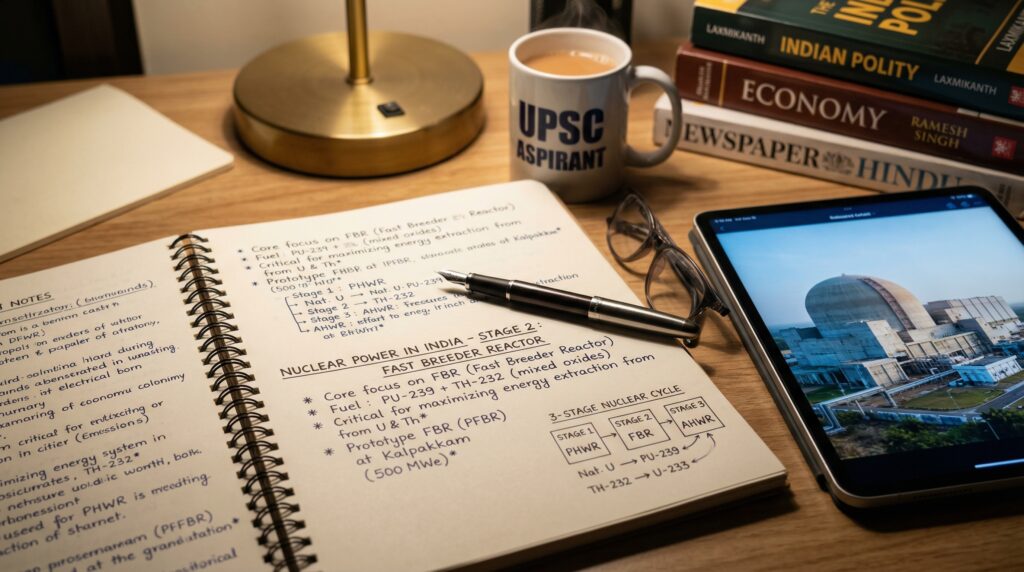
More importantly, this achievement officially marks India’s entry into Stage 2 of our grand Three-Stage Nuclear Power Programme.
The Strategic Canvas: Dr. Bhabha’s Three-Stage Vision
To appreciate the present, we must look at the static backdrop—the visionary roadmap laid down by Dr. Homi J. Bhabha decades ago.
India faces a unique geographical paradox: we have remarkably limited reserves of natural Uranium, but we possess one of the world’s largest reserves of Thorium (found abundantly in the monazite sands of Kerala). The challenge? Thorium cannot undergo fission on its own; it must be converted into a usable fuel. Dr. Bhabha’s solution was a brilliant, closed-loop, three-stage strategy:
- Stage 1: Pressurised Heavy Water Reactors (PHWRs): We use our limited natural Uranium to generate electricity. The critical by-product of this process is Plutonium-239, extracted from the spent fuel.
- Stage 2: Fast Breeder Reactors (FBRs): This is where the Kalpakkam PFBR sits. It uses a Mixed Oxide (MOX) fuel comprising Uranium and the Plutonium-239 obtained from Stage 1. The reactor core is surrounded by a “blanket” of Uranium-238. Fast neutrons hit this blanket, converting it into even more Plutonium-239 (hence, “breeding”). Eventually, this blanket will be replaced by Thorium-232, which the reactor will transmute into Uranium-233.
- Stage 3: Thorium-Based Reactors: Using the Uranium-233 bred in Stage 2, India will finally be able to utilize its vast Thorium reserves, guaranteeing energy independence for centuries.
The Policy Ecosystem and Future Outlook
For the UPSC Main Examination (General Studies Paper III), this scientific leap must be contextualized within India’s broader macroeconomic and environmental goals.
Currently, India’s installed nuclear capacity stands at 8.78 GW, contributing roughly 3.1% to the national electricity mix. However, nuclear energy is no longer viewed as a supplementary power source; it is the cornerstone of India’s clean energy transition.
The Union Budget 2025–26 formally outlined the Nuclear Energy Mission, setting an ambitious target of achieving 100 GW of nuclear power capacity by 2047 (the centenary of India’s independence). This mission is inextricably linked to Prime Minister Modi’s global pledge of achieving Net Zero carbon emissions by 2070.
To drive this vision forward, the government has unleashed a wave of policy and legislative reforms:
- The SHANTI Act, 2025: The Sustainable Harnessing and Advancement of Nuclear Energy for Transforming India Act is a watershed legislation. It modernizes our legal frameworks and, crucially, allows for limited private sector participation in the nuclear domain under strict regulatory oversight. This resolves the long-standing bottleneck of capital infusion.
- Small Modular Reactors (SMRs): The government has earmarked ₹20,000 crore for the development of SMRs, aiming to have five indigenously designed SMRs operational by 2033. The Bhabha Atomic Research Centre (BARC) is already spearheading the Bharat Small Modular Reactor (BSMR-200). SMRs represent the future—they are safer, require less capital, and can be deployed rapidly.
Conclusion: The Administrator’s Perspective
The attainment of criticality at the Kalpakkam PFBR is not merely a victory for the scientists at the Department of Atomic Energy (DAE) and the Indira Gandhi Centre for Atomic Research (IGCAR). It is a textbook example of how long-term policy persistence yields results.
From navigating international nuclear isolation in the late 20th century to signing Civil Nuclear Cooperation agreements with 18 nations today, India’s nuclear journey is a masterclass in strategic autonomy. For you, the future policymakers, the Kalpakkam reactor stands as a shining beacon of Atmanirbhar Bharat. It teaches us that true energy security does not come from importing fuels, but from harnessing indigenous resources through world-class science and steadfast political will.